Wednesday, November 7, 2012

Celebrate the Classics: Robert McCloskey

It would be impossible to do justice to the many classics that have influenced contemporary children's literature, but some illustrators really stand out. One that comes to mind is Robert McCloskey whose work is just as cherished today as it was decades ago. McCloskey's books can grow with your children; Sal herself grows up in a couple of them, starting off with blueberry picking, losing her first tooth one morning in Maine, and then, while not named, looking suspiciously like an older self in Time of Wonder. If you're inspired to learn more about McCloskey and his peers in the early part of the 20th century, check out this terrific essay, published by Horn Book back in the '50s, on What Is a Picture Book.


McCloskey's books are presented in order of age-appeal (youngest to oldest, but there is definite overlap). Every library should have a copy of these books, so ask next time you're in! I don't buy every book we enjoy, but our copies of Blueberries for Sal and Make Way for Ducklings are QUITE worn....Enjoy.

Blueberries for Sal (1948)

Make Way for Ducklings (1941; Caldecott Medal)

One Morning in Maine (1952)

Time of Wonder (1957; Caldecott Medal)

Lentil (1940)

Homer Price (1943; not really a picture book...)


What's YOUR favorite McCloskey book?
cover images from goodreads

Tuesday, November 6, 2012

Celebrate the Classics: Thomas the Tank Engine

I must first credit my insightful husband for his thought-provoking observations which have greatly impacted our family appreciation for Thomas and my understanding of the collection for this review. (Thanks, honey!)

Our boys (5, 3, and 1) love books and trains. Occasionally a sweet friend will give them one (or several) of the Thomas the Tank Engine books, and we noticed that they were taken from the original stories written by the Reverend W. Awdry. Who was Rev. Awdry, and what were the original stories? My husband encouraged me to find out.

Lo and behold, our local library had a copy of Thomas the Tank Engine: The Complete Collection (ISBN 0517187868) which was met with great enthusiasm at our house, not only by my sons but especially by my husband; I was glad to find used copies available online. (Frequent handling thus far has required me to mend our copy once already, and I intend to pursue library binding so it will hold up under many years of use!)

Rev. Wilbert Awdry drew on his childhood love of trains and belief that they had individual personalities when his little son was ill and needed to be amused. His wife persuaded him to pursue publication, and finally the first stories about Edward, Gordon and Henry were published in 1945.

My husband has often commented on the enormous difference between the text of originals and the modern, super-abridged easy readers. Gone are the complex personalities, the depth of lessons learned, the gentle relationships developed between the engines and the "Fat Controller." A simple comparison of the texts will demonstrate my point. Here is the original opening of "Thomas Goes Fishing" from the collection of original stories:

Thomas' branch line had a station by a river. As he rumbled over the bridge, he would see people fishing. Sometimes they stood quietly by their lines; sometimes they were actually jerking fish out of the water.
Thomas often wanted to stay and watch, but his Driver said, "No! what would the Fat Controller say if we were late?"
Thomas thought it would be lovely to stop by the river. "I should like to go fishing," he said to himself longingly.

Here we find onomatopoetic words like "rumbled" and "jerked" and the conflict between duty and pleasure and the self-discipline learned by accountability.
Here is the opening of the easy reader edition:

Thomas chugged by the river.
He saw children fishing.
"Peep, peep!" Thomas said.
The children waved.

So much is lost. Even though this is an easy reader, I believe there is too much sacrificed in the text so that rather than engaging the reader, the child has little reason to care and the parent can't wait to get to the end.

At the conclusion of the original story we learn that the Stationmaster, Driver, Fireman and Fat Controller had a picnic of fish and chips, a merry fellowship dinner, which is so much more satisfying than the abridged version's simple discovery that  there were fish in the boiler. Think of all the examples in children's literature which celebrate food and eating with good company!

A few more of my husband's observations about the collection as a whole, in his words:

"Reading the originals you can learn something about railroads. I could go back to the stories to find railroad terms that I never heard before. The early stories revolve around engines who behave as children who must be disciplined in order to become “Really Useful Engines.” The later stories are a bit more somber, with tales of arrogant, sometimes vicious diesels taking over railroads, with the Fat Controller and others providing a safe haven for steam engines who manage to escape. Take a look at the superior artwork in the originals and how it changes over the years as different illustrators are used."

Great stuff. If you have children who love trains, we heartily recommend finding a copy of the original stories at a library or online!

What's YOUR favorite Thomas the Tank Engine story?

Monday, November 5, 2012

Celebrate the Classics: Beatrix Potter


Perhaps the founder of the modern picture book, we owe a great debt to this intrepid lady. (And, in fact, the Lake District in England owes much debt to her--she left her land in trust and many enjoy her beautiful estate even today.)

Beatrix Potter, as you no doubt know, began her beloved Peter Rabbit tales as letters to young people in her life. She illustrated them based upon her own farm animals and the wild animals she observed. It was her idea to publish the books in small format, "just right for little hands."

If you haven't enjoyed her work in the original small format, please remedy that with your children! The larger compilations of her books are just not the same. I also need hardly say that the stories without her original illustrations... well, what is the point? Why desecrate them in that fashion??!!


My all-time favorites are Mrs. Tiggy-winkle and Jemima Puddleduck. In fact, I love that Jasper Fforde includes Tiggy-winkle in his Thursday Next books. And I've a soft spot in my heart for little hedgehogs (I recently got to pet one at an aquarium and I thought immediately--and fondly--of Mrs. Tiggy-winkle).

My children also frequently request Two Bad Mice and Mr. Jeremy Fisher; there are none that we don't enjoy (and I have all but one ☺).

And Horn Book has a great essay titled Absorbing  Pictures and What They Say up--it features some terrific spreads from some books we will also be mentioning in the coming weeks. Love those classics!

Saturday, November 3, 2012

National Picture Book Month!

November is National Picture Book Month! Megan and I are both BIG fans of the picture book--and not just for the wee ones in your life. There are many, many wonderful picture books for all ages. This month, we hope to highlight some of our favorites, some of which we've reviewed before and some of which will be new ones! While you wait for our special highlights, feel free to check out my 21st Century Picture Book Favorites Pinterest board and my Picture Books: Retro Reads Pinterest board. As with all Pinterest boards, they're a work in progress!

In addition to what we will highlight here on Literaritea, there are some terrific posts on the Picture Book Month website by well known illustrators on the importance of picture books. Megan and I are huge fans of Paul O. Zelinsky, whose "Why Picture Books Are Important" post is up today. I echo his comment about picture books being a bridge to art as well as to storytelling; this is why the quality of the illustrations is so important! I've seen my own children imitating their favorite picture book art in their own drawings (most recently in the plethora of stylized elephants and pigs... ahem).

And so, we'll start off our Picture Book Month Celebration with a few of Zelinsky's own picture books that both Megan and I adore (linked, where applicable, to our reviews). He's also done some worthy illustrations for some of Nesbit's books (such as The Enchanted Castle). You'll note that his style is remarkably diverse...


Z is for Moose by Kelly Bingham (2012)

Toys Go Out by Emily Jenkins (2006) 
(not strictly a picture book, but...)


Rapunzel (1997; Caldecott Medal)

Hansel and Gretel (1984; Caldecott Honor)


Rumpelstiltskin (1996; Caldecott Honor)


Cover images from goodreads

What are some of YOUR favorite picture books? We'll feature some more favorite illustrators and books in the days to some!

Friday, October 26, 2012

Weekly Round-up: Baseball Bios in Picture Book Form

I like to do weekly round-ups on Wednesdays, but I just couldn't get this one done by Wednesday this week. However, I don't want to wait until next week because we're in the middle of the World Series!! A great time to mention these recent baseball picture books.

You may have heard of the new Common Core State Standards for education. If you haven't, don't worry--I plan to discuss them in more detail in the coming weeks. Whether or not your children are in public schools, these standards will affect you; after all, standardized tests are based on things exactly like this! One of the big distinctives of the new standards is the increased emphasis on "informational texts." So far, it's been hard to determine if that includes narrative nonfiction (think: biographies) as well as more information nonfiction.

At any rate, there has been a real boon of well done information picture books as of late. Three of the ones published recently center around a famous person (or persons) in baseball. Check these titles out if you have children interested in baseball, sports in general, or just for some fun "informational" reading.

There Goes Ted Williams: the Greatest Hitter Who Ever Lived
Matt Tavares
Candlewick
2012

Ted Williams could hit a ball...consistently into home run territory. His story is one of hard work, determination to be the best, consistent practice, and service to his country (WWII and Korea). The author provides a bibliography at the end as well as a note which mentions some of Williams's less-than-stellar attributes. It's a terrific story,  nicely illustrated, and a great one to read with a young, aspiring baseball player. Recommended for elementary, particularly those with some prior baseball knowledge.

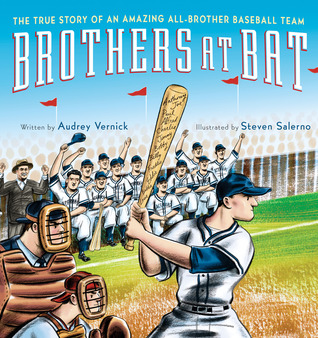
Brothers at Bat: the True Story of an Amazing All-Brother Baseball Team
Audrey Vernick, author
Stephen Salerno, illustrator
Clarion
2012

Well told and wonderfully illustrated, Brothers at Bat tells the story of 12 brothers who formed an all-brother baseball team (the longest playing all-brother team in history). Terrific family dynamics (they also had 4 sisters!), a nice slice of American history (early 20th century, including WWII), and interesting details about particular brothers make this a winner. Recommended for elementary (or earlier if they have some baseball background).

She Loved Baseball: the Effa Manley Story
Audrey Vernick, author
Don Tate, illustrator
Collins
2010

Did you know that there is a woman in the Baseball Hall of Fame? Just one actually: Effa Manley. She was an amazing woman, loved baseball, ended up owning a baseball team, and just had such an interesting life. This one's for those girls in the family who are out in the backyard hitting balls with their brothers! Recommended for elementary.

Thursday, October 18, 2012

The Golden Goblet (Retro Reads)

The Golden Goblet
Eloise Jarvis McGraw
Puffin
1961
Newbery Honor Book

The Golden Goblet is an older book that might be easy to overlook--but don't pass it by! Set in ancient Egypt, The Golden Goblet tells the story of young Ranofer, an orphan who desperately wants to be a goldsmith. It's not that he doesn't have talent; no, it's that his stepbrother (Gebu) is cruel and refuses to pay to apprentice him to a goldsmith. In fact, Ranofer is a lowly worker in a goldsmith's shop until he discovers Gebu's thievery. Once the deception is brought to the attention of the goldsmith, Ranofer is sent to work in the stonecutter's shop--a job that poses risk of harm to Ranofer's skilled artisan fingers in addition to its other hardships.

Friday, October 12, 2012

Shades of Grey


Shades of Grey
Jasper Fforde
Viking Adult
2009
(originally published in the UK in 2008; also published by Penguin in US in 2011)


This is NOT the Fifty Shades of Gray that has stirred up so much discussion--and rightly so--this summer. Nor is it Ruth Sepetys' lovely historical fiction titled Between Shades of Gray (note the different spellings of Gra/ey). No, no, this is a completely different beast altogether. I recently reviewed the latest Fforde offering to hit US shelves (The Last Dragonslayer), but I've long wanted to review this earlier work of his. I've been waiting (waiting!! Hint Hint Mr Fforde!!) for the sequel, but alas...