The Real Boy
Anne Ursu
Walden Pond Press, 2013
I haven't had the privilege of reading Ursu's highly regarded Breadcrumbs, but I'm going to make sure I track that one down soon! The Real Boy was a delight to read, pure and simple. I went into it one idea and one only: a particular legendary children's story, the title of which shouldn't be hard to figure out if you ponder the title of this book long. I also knew folks liked this book; in addition to appearing on mock Newberys (like that on Heavy Medal), it also made the National Book Award long list.
Ursu's writing itself is sheer pleasure to read. I'm a words girl, and I love to read well crafted sentences and the like. Nerdy, huh? I enjoy a well plotted novel, good characters endear themselves to me like real life friends, and musing over a deep theme with a good (real life) friend--lovely. But the words themselves are first and foremost what I notice. I'd wager that it's folks like me who enjoy the likes of Hokey Pokey and other titles that play with language. One of my favorite lines in The Real Boy reads, "And the people were the same way: gilded with plenty, unsullied by suffering." Ursu packs a punch with a succinct prose that will be just as easily read and relished by her target audience (middle grades) as it is by the likes of me. It's not perfect throughout, but there are moments of brilliance.
Thankfully, though, Ursu's prose isn't the only great thing about this novel. I hesitate to write too much about the characters and the plot because so much of the pleasure of reading this book is in the discovery of all that lies beneath the surface. Ursu gives us a wonderful character in Oscar, the real boy, and his friend Callie. I love their growing relationship, the ways they learn to read each other like any two people who are growing closer. Ursu does a great job of showing us this process, not telling. And she does a great job of showing us, not telling us, some of the quirks that any person has--but which Oscar seems to possess in greater abundance. There's no need to label him (finally!) because so many of us have strange little quirks. I'd bet there are lots of (unlabeled) kids who find elements of Oscar's character resonate within their own selves, even if they aren't as extreme in any given area. Callie is a born nurturer, but she's never saccharine about it. I love that. One important note: because the book is told from Oscar's perspective (although in 3rd person), there is lots that the reader must infer. I think this worked well although not everyone agrees with me.
The plot: it's well paced for the most part. Solid world building in the background informs lots of key decisions and moments, and it all hangs together. But the best part: the open ending! Enough is resolved for readers to close the book happily, but there are enough what ifs that we will spend the rest of the day (week) thinking on and musing over them.
Go get a copy and read it for yourself! Do NOT read my questions below unless you have read the book or don't care if you find out "stuff" before reading....
[SPOILER ALERT]
This book brings up great thematic material which would be worth discussing. The biggest issue is greed--and not just greed for more money or material goods. The parents in the Shining City want perfect children because they don't want to see their children suffer. Interesting, isn't it? Sort of a twisted desire to make everything in life perfect--so perfect for your children that, though they look and feel and sound real, they're actually artificial in an attempt to protect them. And don't we want that, too? Don't we go to great lengths to avoid suffering? Aren't we greedy for an easy life, an untroubled one, one that's "unsullied by suffering"?
My biggest question from this book, though: I totally thought the trees being cut down were the reason the children made from them were suddenly failing. I guess I get the idea of a "hole" in the world where Magic used to bind it together, but to me it made more sense to directly connect each particular tree with the children who were made from its wood. Anyone else?
Book from local library; cover image from publisher's site
Showing posts with label Boy Protagonist(s). Show all posts
Monday, November 25, 2013
Monday, September 16, 2013
Mister Max: The Book of Lost Things
Mister Max: The Book of Lost Things (Mister Max, Book 1)
Cynthia Voigt
Iacopo Bruno, illustrator
Knopf, 2013
Voigt is a well known author, to be sure (especially for her Tillerman books--Dicey's Song was a Newbery winner from back in the day). She also won the Margaret A. Edwards award in 1995 (for lifetime achievement). And yet, we haven't heard much from her in recent years.
There's no question that Voigt can write, and write well at that. On the surface, her latest book seemed tailor made for me: I love a good mystery. I enjoy historic time periods and settings. I relish a good, open ending. Quirky characters, a dog, some art, the life of the theater--what's not to like?
When the book opens, Max's parents--both actors and owners of the Starling Theater Company--are planning a monumental trip to India. Max gets to go along. Until the day his parents board the boat and the boat leaves...without him. But, because Max is a quick thinker, he soon finds out that the boat they were supposed to board didn't exist. Therefore, did the whole trip exist? Are his parents in trouble? Did they know about this ahead of time? Is this an elaborate game or some nefarious plot? The reader doesn't know either, and we spend the next several hundred pages working on this mystery along with Max.
Thankfully, Max's grandmother lives close by, so he's not completely alone at the tender age of 12. He also has his painting instructor, a new tutor, and a new spunky girl to help him make sense of life and survive. And survive he does through his newly created "Mister Max" business: he solves minor mysteries for hire. Each time Max shows up for a new job, he's crafted a new disguise using his parents' many costumes. Thus, no one knows it's really a twelve year old boy underneath.
By the end of the book, we've learned a lot about Max and his parents (including where they are, although not how/why they got there), and Max has helped long lost lovers reunite, his painting instructor discover a new technique, and made some good friends. We're nicely set up, too, for the next book in the series.
And yet... Frankly, this book was too long. I finished it several weeks ago and am still mulling over just what didn't work. I enjoyed the characterization both of Max and the supporting cast. I enjoyed the overall dramatic framework of the book ("Act I"). But the length of the book draws out the mystery surrounding the parents' disappearance a little too long. We're bored with where his parents might be by the end and are much more invested in the here and now with Max and his new friends.
Age recommendation: 9-12/middle grades
Cover image from publisher
Thanks to publisher via netgalley for ARC!
Cynthia Voigt
Iacopo Bruno, illustrator
Knopf, 2013
Voigt is a well known author, to be sure (especially for her Tillerman books--Dicey's Song was a Newbery winner from back in the day). She also won the Margaret A. Edwards award in 1995 (for lifetime achievement). And yet, we haven't heard much from her in recent years.
There's no question that Voigt can write, and write well at that. On the surface, her latest book seemed tailor made for me: I love a good mystery. I enjoy historic time periods and settings. I relish a good, open ending. Quirky characters, a dog, some art, the life of the theater--what's not to like?
When the book opens, Max's parents--both actors and owners of the Starling Theater Company--are planning a monumental trip to India. Max gets to go along. Until the day his parents board the boat and the boat leaves...without him. But, because Max is a quick thinker, he soon finds out that the boat they were supposed to board didn't exist. Therefore, did the whole trip exist? Are his parents in trouble? Did they know about this ahead of time? Is this an elaborate game or some nefarious plot? The reader doesn't know either, and we spend the next several hundred pages working on this mystery along with Max.
Thankfully, Max's grandmother lives close by, so he's not completely alone at the tender age of 12. He also has his painting instructor, a new tutor, and a new spunky girl to help him make sense of life and survive. And survive he does through his newly created "Mister Max" business: he solves minor mysteries for hire. Each time Max shows up for a new job, he's crafted a new disguise using his parents' many costumes. Thus, no one knows it's really a twelve year old boy underneath.
By the end of the book, we've learned a lot about Max and his parents (including where they are, although not how/why they got there), and Max has helped long lost lovers reunite, his painting instructor discover a new technique, and made some good friends. We're nicely set up, too, for the next book in the series.
And yet... Frankly, this book was too long. I finished it several weeks ago and am still mulling over just what didn't work. I enjoyed the characterization both of Max and the supporting cast. I enjoyed the overall dramatic framework of the book ("Act I"). But the length of the book draws out the mystery surrounding the parents' disappearance a little too long. We're bored with where his parents might be by the end and are much more invested in the here and now with Max and his new friends.
Age recommendation: 9-12/middle grades
Cover image from publisher
Thanks to publisher via netgalley for ARC!
Labels:
Adventure,
ARC,
Boy Protagonist(s),
Historical Fiction,
Middle Grades,
Mystery
Wednesday, June 26, 2013
Jasper John Dooley: Left Behind
Caroline Adderson, author
Ben Clanton, illustrator
Kids Can Press, 2013
When I reviewed the first Jasper John Dooley book, I compared him to Junie B. Jones (Jasper John Dooley is my kind of character; Junie B.? not so much). And since I like little Jasper John so much, I was delighted to get to read an ARC of the second.
Now, I must confess....that second book has now been out long enough now to be IN MY LIBRARY. Shame on me for "sitting" on this review for so long. But there it is. Life sometimes intervenes. Best laid plans and all...
So, without further ado, let's revisit Jasper John. In this charming second book--which I might like even better than the first!--Jasper is bidding his grandmother farewell as she leaves for a cruise. He usually spends one afternoon a week with his grandmother. Jasper's character is spot on for a first grade boy. I love the things he does while she's gone--things that make perfect sense to a six-year-old. For instance, he catches rain water and air in different little cups so he can share them with his Nan when she returns. He feels deflated when she's gone, and the descriptions of his emotions are pitch perfect for 1st and 2nd graders. They will relate.
This book makes a great read aloud to K-2nd graders and also a PERFECT early chapter book if kids in that age group can read. We have too few solid books about boys in this category. If you need a good summer reading choice for those hot days coming in July, check out little Jasper John Dooley!
Book in ARC form from publisher and via netgalley; cover image from goodreads
Caroline Adderson, author
Ben Clanton, illustrator
Kids Can Press, 2013
When I reviewed the first Jasper John Dooley book, I compared him to Junie B. Jones (Jasper John Dooley is my kind of character; Junie B.? not so much). And since I like little Jasper John so much, I was delighted to get to read an ARC of the second.
Now, I must confess....that second book has now been out long enough now to be IN MY LIBRARY. Shame on me for "sitting" on this review for so long. But there it is. Life sometimes intervenes. Best laid plans and all...
So, without further ado, let's revisit Jasper John. In this charming second book--which I might like even better than the first!--Jasper is bidding his grandmother farewell as she leaves for a cruise. He usually spends one afternoon a week with his grandmother. Jasper's character is spot on for a first grade boy. I love the things he does while she's gone--things that make perfect sense to a six-year-old. For instance, he catches rain water and air in different little cups so he can share them with his Nan when she returns. He feels deflated when she's gone, and the descriptions of his emotions are pitch perfect for 1st and 2nd graders. They will relate.
This book makes a great read aloud to K-2nd graders and also a PERFECT early chapter book if kids in that age group can read. We have too few solid books about boys in this category. If you need a good summer reading choice for those hot days coming in July, check out little Jasper John Dooley!
Book in ARC form from publisher and via netgalley; cover image from goodreads
Monday, March 11, 2013
Mirage (Above World #2)
Mirage
Jenn Reese
Candlewick, 2013
Wow. This is one of those second-book-in-a-series that assumes you have read the first-in-the-series and can keep up! With very little preamble, we are immediately plunged back into the world of Aluna and her best friend Hoku, both Kampii, and their friends Calli (who has wings) and Dash, an Equian. If those descriptions means nothing to you, read no further. Just go read Above World quickly so you can catch up!
The four friends attempt again to thwart the nefarious Karl Strand and one of his clones in this fast-paced book. Trying desperately to arrive at Mirage (an aptly named desert city in the middle of Equian country), the friends find their plans constantly shifting and changing--much like the terrain they are crossing. As the book progresses with rapidly advancing plot, they meet new friends and form new alliances. We meet the Serpenti--a race of people adapted to live as snakes do. We understand more of Dash's personal history as well as that of another "failed" Equian, Tal. We watch Aluna struggle to admit her need for and dependence on her friends, and we watch a gripping showdown in which the ending is brilliantly done. I love it when an author doesn't give us the expected ending! Aluna "grows up" a bit in this book as she suffers the side effects of the pill she swallowed at the end of the last book--the pill the Kampii swallow to generate their trademark tale.
I'll confess that I didn't find the writing style as distinguished in this book as in Above World. Still, for fans of Above World, this is a fun sequel to be sure. Similar thought-provoking discussions will result, as well: what makes us human? When is too much tech, well, too much? What assumptions do we make about others based simply on appearances or quickly formed judgements from one action? When does our pride get in the way of a true friendship (either with people we already know or with those we've pre-maturely judged)? When is tradition important and when should it alter to fit the new times we're living in?
Clearly we are headed for more in this series; Karl Strand is still out there, and Aluna and her band are stronger than ever!
Recommended for middle grades, especially those who enjoy fantasy/sci-fi! Look for Mirage in book stores this week, and hopefully on library shelves soon, too!
Cover image from netgalley; ARC of book thanks to netgalley as well!
Jenn Reese
Candlewick, 2013
Wow. This is one of those second-book-in-a-series that assumes you have read the first-in-the-series and can keep up! With very little preamble, we are immediately plunged back into the world of Aluna and her best friend Hoku, both Kampii, and their friends Calli (who has wings) and Dash, an Equian. If those descriptions means nothing to you, read no further. Just go read Above World quickly so you can catch up!
The four friends attempt again to thwart the nefarious Karl Strand and one of his clones in this fast-paced book. Trying desperately to arrive at Mirage (an aptly named desert city in the middle of Equian country), the friends find their plans constantly shifting and changing--much like the terrain they are crossing. As the book progresses with rapidly advancing plot, they meet new friends and form new alliances. We meet the Serpenti--a race of people adapted to live as snakes do. We understand more of Dash's personal history as well as that of another "failed" Equian, Tal. We watch Aluna struggle to admit her need for and dependence on her friends, and we watch a gripping showdown in which the ending is brilliantly done. I love it when an author doesn't give us the expected ending! Aluna "grows up" a bit in this book as she suffers the side effects of the pill she swallowed at the end of the last book--the pill the Kampii swallow to generate their trademark tale.
I'll confess that I didn't find the writing style as distinguished in this book as in Above World. Still, for fans of Above World, this is a fun sequel to be sure. Similar thought-provoking discussions will result, as well: what makes us human? When is too much tech, well, too much? What assumptions do we make about others based simply on appearances or quickly formed judgements from one action? When does our pride get in the way of a true friendship (either with people we already know or with those we've pre-maturely judged)? When is tradition important and when should it alter to fit the new times we're living in?
Clearly we are headed for more in this series; Karl Strand is still out there, and Aluna and her band are stronger than ever!
Recommended for middle grades, especially those who enjoy fantasy/sci-fi! Look for Mirage in book stores this week, and hopefully on library shelves soon, too!
Cover image from netgalley; ARC of book thanks to netgalley as well!
Labels:
ARC,
Boy Protagonist(s),
Fantasy,
Girl Protagonist(s),
Middle Grades
Monday, March 4, 2013
Finding Zasha: another great boy + dog story
Finding Zasha
Randi Barrow
Scholastic, 2013
Finding Zasha is a prequel to the popular Saving Zasha. I never read Saving Zasha, so I read Finding Zasha "cold" with no pre-existing ideas. And I thoroughly enjoyed it. I'm a sucker for good boy + dog stories, and in this case, it's boy + 2 dogs + Russia during WWII.
When the story opens, 12-year-old Ivan is living with his mother in an apartment in Leningrad as the famous siege of Leningrad begins. Ivan and his older neighbor (an "aunt") flee the city on a dangerous journey which involved crossing a iced-over river, catching a ride with a stranger, and showing up unannounced at a distant relative's house. Once they arrive in their new rural town, Ivan quickly makes friends with the local resistance fighters and joins them--none too soon, it turns out, because the Germans are moving in quickly. Ivan ends up getting chosen by the brutal commander of this particular German force--Axel--to play music for him and to train Axel's two adorable German Shepherd puppies.
I won't give away the rest of the book. Suffice it to say that Ivan forms a tremendous bond with his two canine charges, hatches a daring escape plan for them and him both (and other resistance fighters), endures another harrowing journey across unforgiving winter Russia, and... you'll just have to read it! Those who enjoyed the first Zasha book will enjoy this one. This one ends on a cliff hanger--which makes sense if you've read the first book, but which I had to do a little research about since I haven't read the first book.
Zasha is a bit too long for my tastes and will challenge some early middle school students. Still it's a good fit for the middle grades age group.
Truth and Story: This is a very engaging story, but the Truth aspects were a little off to me. From what I understand of Russia, the time period, and any group of people in wartime, I though it noteworthy that there was scant mention of religion of any sort. It doesn't "ruin" the story, but I noticed. Still, it provides a good picture of a boy hero, a brave group standing together at great risk, and what wartime can do to people.
Finding Zasha should be on shelves in bookstores now and will no doubt follow soon to library shelves.
ARC from netgalley; cover image from goodreads
Randi Barrow
Scholastic, 2013
Finding Zasha is a prequel to the popular Saving Zasha. I never read Saving Zasha, so I read Finding Zasha "cold" with no pre-existing ideas. And I thoroughly enjoyed it. I'm a sucker for good boy + dog stories, and in this case, it's boy + 2 dogs + Russia during WWII.
When the story opens, 12-year-old Ivan is living with his mother in an apartment in Leningrad as the famous siege of Leningrad begins. Ivan and his older neighbor (an "aunt") flee the city on a dangerous journey which involved crossing a iced-over river, catching a ride with a stranger, and showing up unannounced at a distant relative's house. Once they arrive in their new rural town, Ivan quickly makes friends with the local resistance fighters and joins them--none too soon, it turns out, because the Germans are moving in quickly. Ivan ends up getting chosen by the brutal commander of this particular German force--Axel--to play music for him and to train Axel's two adorable German Shepherd puppies.
I won't give away the rest of the book. Suffice it to say that Ivan forms a tremendous bond with his two canine charges, hatches a daring escape plan for them and him both (and other resistance fighters), endures another harrowing journey across unforgiving winter Russia, and... you'll just have to read it! Those who enjoyed the first Zasha book will enjoy this one. This one ends on a cliff hanger--which makes sense if you've read the first book, but which I had to do a little research about since I haven't read the first book.
Zasha is a bit too long for my tastes and will challenge some early middle school students. Still it's a good fit for the middle grades age group.
Truth and Story: This is a very engaging story, but the Truth aspects were a little off to me. From what I understand of Russia, the time period, and any group of people in wartime, I though it noteworthy that there was scant mention of religion of any sort. It doesn't "ruin" the story, but I noticed. Still, it provides a good picture of a boy hero, a brave group standing together at great risk, and what wartime can do to people.
Finding Zasha should be on shelves in bookstores now and will no doubt follow soon to library shelves.
ARC from netgalley; cover image from goodreads
Tuesday, January 8, 2013
Hokey Pokey
Hokey Pokey
Jerry Spinelli
Knopf (Random House)
2013
You put your right foot in
You put your right out out
You put your right foot in
And you shake it all about
You do the hokey pokey
And you turn yourself about
That's what it's all about...
And that sums up Hokey Pokey, Newbery Medalist (Maniac Magee) Spinelli's latest middle grades offering. It sums it up brilliantly, in fact.
For the second time this week, I'm reviewing a work by an author whose former work I wasn't so keen on. Although people really seemed to love Maniac Magee, I wasn't wowed. Maybe I need to give it another chance and read some of Spinelli's other works as well because I really enjoyed Hokey Pokey. And for the second time this week, I'm reviewing a book about a boy named Jack that involves a bit of magical realism. Funny how those things seem to be cyclical.
And yet Hokey Pokey is nothing like Navigating Early, despite their main character's names. Hokey Pokey takes us back to the world of childhood and shows us what the seemingly overnight transition to adulthood is like. And it does indeed happen overnight.
Spinelli's world of Hokey Pokey was terrific. I loved his new compound words ("bestfriendship," "dropflopping," "shadowblur"). I loved his place names ("Tantrums," "Thousand Puddles"). I loved the feel of Hokey Pokey: an iconic place of childhood activity where children drink Hokey Pokeys when the Hokey Pokey man comes (like the ice cream truck), play on the playground, and bike everywhere on their two-wheeled steeds. The only electronic device in the picture was the giant cartoons screen where the youngest children liked to gather. Even when we hit our present, real world at the end of the book, we still only read about one TV.
Jack's coming-of-age in this book is not because of some great event he lives through or some momentous decision he must make. Instead, it is simply time to grow up and involves much more prosaic decisions like changing out his childish wallpaper to something more grown-up...or does it? Spinelli gives us a work in which the monumental shift from childhood to adulthood is seen for its significance, even if it's evidenced by a small decision to not leave dirty socks on the floor.
This is one of those books that is hard for me to peg in terms of its young audience. I wonder, in fact, if it's a book that grownups will enjoy more. Will a middle school student recognize the transformation as quickly? Will it resonate with him or her like it does for those of us who navigated the shift years ago? Will younger readers feel as nostalgic about such cartoons as Bugs Bunny and such games as jacks or simply riding bikes? I don't know. It's certainly worth finding out because Spinelli's Hokey Pokey is fantastic.
Things to Note/Discuss
Jerry Spinelli
Knopf (Random House)
2013
You put your right foot in
You put your right out out
You put your right foot in
And you shake it all about
You do the hokey pokey
And you turn yourself about
That's what it's all about...
And that sums up Hokey Pokey, Newbery Medalist (Maniac Magee) Spinelli's latest middle grades offering. It sums it up brilliantly, in fact.
For the second time this week, I'm reviewing a work by an author whose former work I wasn't so keen on. Although people really seemed to love Maniac Magee, I wasn't wowed. Maybe I need to give it another chance and read some of Spinelli's other works as well because I really enjoyed Hokey Pokey. And for the second time this week, I'm reviewing a book about a boy named Jack that involves a bit of magical realism. Funny how those things seem to be cyclical.
And yet Hokey Pokey is nothing like Navigating Early, despite their main character's names. Hokey Pokey takes us back to the world of childhood and shows us what the seemingly overnight transition to adulthood is like. And it does indeed happen overnight.
Spinelli's world of Hokey Pokey was terrific. I loved his new compound words ("bestfriendship," "dropflopping," "shadowblur"). I loved his place names ("Tantrums," "Thousand Puddles"). I loved the feel of Hokey Pokey: an iconic place of childhood activity where children drink Hokey Pokeys when the Hokey Pokey man comes (like the ice cream truck), play on the playground, and bike everywhere on their two-wheeled steeds. The only electronic device in the picture was the giant cartoons screen where the youngest children liked to gather. Even when we hit our present, real world at the end of the book, we still only read about one TV.
Jack's coming-of-age in this book is not because of some great event he lives through or some momentous decision he must make. Instead, it is simply time to grow up and involves much more prosaic decisions like changing out his childish wallpaper to something more grown-up...or does it? Spinelli gives us a work in which the monumental shift from childhood to adulthood is seen for its significance, even if it's evidenced by a small decision to not leave dirty socks on the floor.
This is one of those books that is hard for me to peg in terms of its young audience. I wonder, in fact, if it's a book that grownups will enjoy more. Will a middle school student recognize the transformation as quickly? Will it resonate with him or her like it does for those of us who navigated the shift years ago? Will younger readers feel as nostalgic about such cartoons as Bugs Bunny and such games as jacks or simply riding bikes? I don't know. It's certainly worth finding out because Spinelli's Hokey Pokey is fantastic.
Things to Note/Discuss
- What does growing up mean? How do we help our children navigate that transition?
- What does "faith like a child" mean?
- Is there a true sense in which we need to grow up? How does our world encourage children to grow up in ways that aren't as positive?
Thursday, January 3, 2013
The Terrible Thing That Happened to Barnaby Brockett
John Boyne, author
Oliver Jeffers, illustrator
Random House (Alfred A. Knopf BFYR)
2012
I was drawn to this book because I like quirky stories, and I'm a huge fan of Oliver Jeffers (the illustrator). And, this book comes out on my birthday! (at least in the U.S.)
This book started out great! Poor Barnaby Brockett, born to terrible parents, sibling to two very ordinary kids, and master to one devoted dog. The book reads much as a classic Roald Dahl book might (complete with TERRIBLE parents!), and Jeffers's illustrations add a similar touch as Quentin Blake's might.
John Boyne, author
Oliver Jeffers, illustrator
Random House (Alfred A. Knopf BFYR)
2012
I was drawn to this book because I like quirky stories, and I'm a huge fan of Oliver Jeffers (the illustrator). And, this book comes out on my birthday! (at least in the U.S.)
This book started out great! Poor Barnaby Brockett, born to terrible parents, sibling to two very ordinary kids, and master to one devoted dog. The book reads much as a classic Roald Dahl book might (complete with TERRIBLE parents!), and Jeffers's illustrations add a similar touch as Quentin Blake's might.
Labels:
Adventure,
ARC,
Boy Protagonist(s),
Fantasy,
Middle Grades
Tuesday, January 1, 2013
Navigating Early
Navigating Early
Clare Vanderpool
Random House
2013
My birthday (Jan 8) this year is a popular release date for the first batch of middle grade novels--if the three I've read are any indication! And not just any ol' bunch of middle grade novels... these are by big time folks. Vanderpool's name might not mean much to our Literaritea readers, but her first middle grade novel won that little Newbery award a couple of years back (Moon Over Manifest). Yes, indeed. And any time a former Newbery winner releases another book, you better believe we jump on it. So I did. And Random House kindly let me read it in ARC form (thanks RH!).
When I read an Advanced Reader Copy, I frequently jump into the book "cold." That is, I know little to nothing of the plot, see no other praise/comments such as might appear on the book cover, and frequently don't see a cover (or a poor image of one). Thus, I enter the reading experience with no preconceptions except those based on my previous reading of the same author's works. Definitely true in the case of Navigating Early. I didn't even know how long it was because I was too lazy to scan the small font on the first ARC page that would have told me that info.
I wasn't wowed by Moon Over Manifest, I'll be honest. Navigating Early is a much stronger work in my opinion. Another historical fiction work, this time set just at the end of WWII in a boys' boarding school in Maine, Navigating Early follows one boy's journey to come to grips with his mother's death and his father's seeming unconcern for him. In the process, he meets the unique Early Auden, goes on a fantastical voyage that weaves in and out of the mythic story of Pi (including the discovery of further numbers), and helps bring closure to more than one person in Early's famous family.
If Early Auden were living today, we would diagnose him somewhere on the autism spectrum--probably Asberger's. I really like that he is NOT diagnosed in this book (he wouldn't have been labeled in the WWII time period either). I think this adds to his character significantly. We want to label people in so many ways; isn't it better to befriend them and learn from them regardless of what label they might carry? Jack learns that Early is a true friend. And Jack learns how to be a friend back.
Early teaches Jack many things on their voyage to find the giant bear, to follow Pi's journey, and to complete their quest. What Jack doesn't know is that Early's absolute conviction of his brother's survival from war (against ALL official evidence), his knowledge of the mathematical intricacies involved in the number Pi, and his childlike faith in the details he notices are all true--even though the casual observer would never believe it. Early notices myriad details that others miss, perhaps because he's not so caught up in the social issues that bog most folks down. Part magical realism, part quest, and all friendship, this story works for me better than Moon Over Manifest. It's a touch too long and struggles a bit with the voice--sounds more like an adult narrating than Jack many times. Still, it's worth reading, and I think many sensitive young readers will enjoy this one.
Clare Vanderpool
Random House
2013
My birthday (Jan 8) this year is a popular release date for the first batch of middle grade novels--if the three I've read are any indication! And not just any ol' bunch of middle grade novels... these are by big time folks. Vanderpool's name might not mean much to our Literaritea readers, but her first middle grade novel won that little Newbery award a couple of years back (Moon Over Manifest). Yes, indeed. And any time a former Newbery winner releases another book, you better believe we jump on it. So I did. And Random House kindly let me read it in ARC form (thanks RH!).
When I read an Advanced Reader Copy, I frequently jump into the book "cold." That is, I know little to nothing of the plot, see no other praise/comments such as might appear on the book cover, and frequently don't see a cover (or a poor image of one). Thus, I enter the reading experience with no preconceptions except those based on my previous reading of the same author's works. Definitely true in the case of Navigating Early. I didn't even know how long it was because I was too lazy to scan the small font on the first ARC page that would have told me that info.
I wasn't wowed by Moon Over Manifest, I'll be honest. Navigating Early is a much stronger work in my opinion. Another historical fiction work, this time set just at the end of WWII in a boys' boarding school in Maine, Navigating Early follows one boy's journey to come to grips with his mother's death and his father's seeming unconcern for him. In the process, he meets the unique Early Auden, goes on a fantastical voyage that weaves in and out of the mythic story of Pi (including the discovery of further numbers), and helps bring closure to more than one person in Early's famous family.
If Early Auden were living today, we would diagnose him somewhere on the autism spectrum--probably Asberger's. I really like that he is NOT diagnosed in this book (he wouldn't have been labeled in the WWII time period either). I think this adds to his character significantly. We want to label people in so many ways; isn't it better to befriend them and learn from them regardless of what label they might carry? Jack learns that Early is a true friend. And Jack learns how to be a friend back.
Early teaches Jack many things on their voyage to find the giant bear, to follow Pi's journey, and to complete their quest. What Jack doesn't know is that Early's absolute conviction of his brother's survival from war (against ALL official evidence), his knowledge of the mathematical intricacies involved in the number Pi, and his childlike faith in the details he notices are all true--even though the casual observer would never believe it. Early notices myriad details that others miss, perhaps because he's not so caught up in the social issues that bog most folks down. Part magical realism, part quest, and all friendship, this story works for me better than Moon Over Manifest. It's a touch too long and struggles a bit with the voice--sounds more like an adult narrating than Jack many times. Still, it's worth reading, and I think many sensitive young readers will enjoy this one.
Labels:
Adventure,
ARC,
Boy Protagonist(s),
Historical Fiction,
Middle Grades
Wednesday, December 12, 2012
What Came From the Stars
Gary D. Schmidt
Clarion
2012
I'm a huge fan of the books of Gary Schmidt's I've read to date (Lizzie Bright and the Buckminster Boy, Okay for Now, and The Wednesday Wars). So I was thrilled to win a goodreads "first reads" giveaway. I got an ARC for this book in the mail the week the hardcover hit bookstore shelves in September. I must confess that the first chapter really threw me--I knew this was a fantasy (a deviation from Schmidt's award-winning historical fiction novels), but it still threw me.
Gary D. Schmidt
Clarion
2012
I'm a huge fan of the books of Gary Schmidt's I've read to date (Lizzie Bright and the Buckminster Boy, Okay for Now, and The Wednesday Wars). So I was thrilled to win a goodreads "first reads" giveaway. I got an ARC for this book in the mail the week the hardcover hit bookstore shelves in September. I must confess that the first chapter really threw me--I knew this was a fantasy (a deviation from Schmidt's award-winning historical fiction novels), but it still threw me.
Tuesday, December 11, 2012
Lizzie Bright and the Buckminster Boy
Gary D. Schmidt
Clarion
2004
Newbery Honor; Printz Honor
This is an excellent book! As you might surmise from those award stickers on the cover, I'm not the only one who thinks so. Historical fiction is Schmidt's strong suit; this particular book takes place in Maine in 1912 and centers on the white Buckminster Boy (Turner) and the black Lizzie Bright. Turner and Lizzie also represent town and country (island in this case), establishment and fringe, the way-it's-always-been and the way-it-should-and-could-be. All of this potential conflict set in a small town that's slowly dying as it faces the end of the industry that's kept it alive.
Turner grows up in this book. He makes hard decisions, stands up for what he believes is right, and watches those "right" decisions still not end happily all the time. A pitch perfect book for the 12-14 crowd, this is a book that raises great questions. Schmidt's biblical allusions are an added treat for those steeped in biblical literacy; his characterization is especially well done in this novel.
Things to Note/Discuss
Gary D. Schmidt
Clarion
2004
Newbery Honor; Printz Honor
This is an excellent book! As you might surmise from those award stickers on the cover, I'm not the only one who thinks so. Historical fiction is Schmidt's strong suit; this particular book takes place in Maine in 1912 and centers on the white Buckminster Boy (Turner) and the black Lizzie Bright. Turner and Lizzie also represent town and country (island in this case), establishment and fringe, the way-it's-always-been and the way-it-should-and-could-be. All of this potential conflict set in a small town that's slowly dying as it faces the end of the industry that's kept it alive.
Turner grows up in this book. He makes hard decisions, stands up for what he believes is right, and watches those "right" decisions still not end happily all the time. A pitch perfect book for the 12-14 crowd, this is a book that raises great questions. Schmidt's biblical allusions are an added treat for those steeped in biblical literacy; his characterization is especially well done in this novel.
Things to Note/Discuss
- When is it okay to stand up to a parent?
- Are there decisions that Turner made that you feel are particularly noteworthy? Were there any you disagreed with or thought foolish?
- What do you think Turner's father should have done in regards to the island (Malaga) and its people?
- Any thoughts on looking a whale in its eye?
Monday, December 10, 2012
Trouble by Gary Schmidt: a Teabag Review
It's no secret that Megan and I enjoy a good cup of tea. So, in honor of our tea appreciation, I'm introducing a new review style: a teabag-sized review. You might consider our normal reviews to be a cup of tea to savor; a teabag is the short and sweet alternative, similar in length to a title's discussion in a weekly round-up but which appears all by its lonesome. Sometimes, we just want to let you know a book is out there! So, without further ado, here's a teabag-sized review of Trouble by Gary Schmidt.
Trouble
Gary D. Schmidt
Clarion, 2008
Trouble takes place near Trouble (a location) and involves heaps of trouble in the lives of young Henry, his family, and a Cambodian named Chay. Schmidt's gift for description, intricate plotting, and terrific characterization come into play, as does his frequent treatment of a young person turning his/her face to adulthood--with all the drama and coming-of-age that implies. This is a book for an older audience than Schmidt's Okay for Now and The Wednesday Wars; I'd even say it's for an older audience than Lizzie Bright and the Buckminster Boy. Issues that crop up include racism, guilt/innocence, family relations, friendship. A touch long, in my opinion, and therefore a touch slow, this book is still a good read and one to provoke much thought.
Trouble
Gary D. Schmidt
Clarion, 2008
Trouble takes place near Trouble (a location) and involves heaps of trouble in the lives of young Henry, his family, and a Cambodian named Chay. Schmidt's gift for description, intricate plotting, and terrific characterization come into play, as does his frequent treatment of a young person turning his/her face to adulthood--with all the drama and coming-of-age that implies. This is a book for an older audience than Schmidt's Okay for Now and The Wednesday Wars; I'd even say it's for an older audience than Lizzie Bright and the Buckminster Boy. Issues that crop up include racism, guilt/innocence, family relations, friendship. A touch long, in my opinion, and therefore a touch slow, this book is still a good read and one to provoke much thought.
Friday, October 26, 2012
Weekly Round-up: Baseball Bios in Picture Book Form
I like to do weekly round-ups on Wednesdays, but I just couldn't get this one done by Wednesday this week. However, I don't want to wait until next week because we're in the middle of the World Series!! A great time to mention these recent baseball picture books.
You may have heard of the new Common Core State Standards for education. If you haven't, don't worry--I plan to discuss them in more detail in the coming weeks. Whether or not your children are in public schools, these standards will affect you; after all, standardized tests are based on things exactly like this! One of the big distinctives of the new standards is the increased emphasis on "informational texts." So far, it's been hard to determine if that includes narrative nonfiction (think: biographies) as well as more information nonfiction.
At any rate, there has been a real boon of well done information picture books as of late. Three of the ones published recently center around a famous person (or persons) in baseball. Check these titles out if you have children interested in baseball, sports in general, or just for some fun "informational" reading.
There Goes Ted Williams: the Greatest Hitter Who Ever Lived
Matt Tavares
Candlewick
2012
Ted Williams could hit a ball...consistently into home run territory. His story is one of hard work, determination to be the best, consistent practice, and service to his country (WWII and Korea). The author provides a bibliography at the end as well as a note which mentions some of Williams's less-than-stellar attributes. It's a terrific story, nicely illustrated, and a great one to read with a young, aspiring baseball player. Recommended for elementary, particularly those with some prior baseball knowledge.
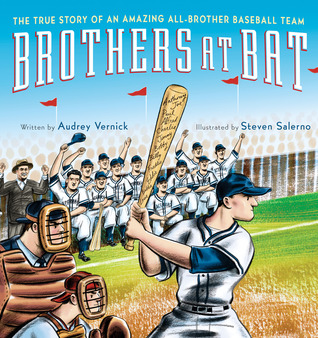
Brothers at Bat: the True Story of an Amazing All-Brother Baseball Team
Audrey Vernick, author
Stephen Salerno, illustrator
Clarion
2012
Well told and wonderfully illustrated, Brothers at Bat tells the story of 12 brothers who formed an all-brother baseball team (the longest playing all-brother team in history). Terrific family dynamics (they also had 4 sisters!), a nice slice of American history (early 20th century, including WWII), and interesting details about particular brothers make this a winner. Recommended for elementary (or earlier if they have some baseball background).
She Loved Baseball: the Effa Manley Story
Audrey Vernick, author
Don Tate, illustrator
Collins
2010
Did you know that there is a woman in the Baseball Hall of Fame? Just one actually: Effa Manley. She was an amazing woman, loved baseball, ended up owning a baseball team, and just had such an interesting life. This one's for those girls in the family who are out in the backyard hitting balls with their brothers! Recommended for elementary.
You may have heard of the new Common Core State Standards for education. If you haven't, don't worry--I plan to discuss them in more detail in the coming weeks. Whether or not your children are in public schools, these standards will affect you; after all, standardized tests are based on things exactly like this! One of the big distinctives of the new standards is the increased emphasis on "informational texts." So far, it's been hard to determine if that includes narrative nonfiction (think: biographies) as well as more information nonfiction.
At any rate, there has been a real boon of well done information picture books as of late. Three of the ones published recently center around a famous person (or persons) in baseball. Check these titles out if you have children interested in baseball, sports in general, or just for some fun "informational" reading.
There Goes Ted Williams: the Greatest Hitter Who Ever Lived
Matt Tavares
Candlewick
2012
Ted Williams could hit a ball...consistently into home run territory. His story is one of hard work, determination to be the best, consistent practice, and service to his country (WWII and Korea). The author provides a bibliography at the end as well as a note which mentions some of Williams's less-than-stellar attributes. It's a terrific story, nicely illustrated, and a great one to read with a young, aspiring baseball player. Recommended for elementary, particularly those with some prior baseball knowledge.
Brothers at Bat: the True Story of an Amazing All-Brother Baseball Team
Audrey Vernick, author
Stephen Salerno, illustrator
Clarion
2012
Well told and wonderfully illustrated, Brothers at Bat tells the story of 12 brothers who formed an all-brother baseball team (the longest playing all-brother team in history). Terrific family dynamics (they also had 4 sisters!), a nice slice of American history (early 20th century, including WWII), and interesting details about particular brothers make this a winner. Recommended for elementary (or earlier if they have some baseball background).
She Loved Baseball: the Effa Manley Story
Audrey Vernick, author
Don Tate, illustrator
Collins
2010
Did you know that there is a woman in the Baseball Hall of Fame? Just one actually: Effa Manley. She was an amazing woman, loved baseball, ended up owning a baseball team, and just had such an interesting life. This one's for those girls in the family who are out in the backyard hitting balls with their brothers! Recommended for elementary.
Thursday, October 18, 2012
The Golden Goblet (Retro Reads)
The Golden Goblet
Eloise Jarvis McGraw
Puffin
1961
Newbery Honor Book
The Golden Goblet is an older book that might be easy to overlook--but don't pass it by! Set in ancient Egypt, The Golden Goblet tells the story of young Ranofer, an orphan who desperately wants to be a goldsmith. It's not that he doesn't have talent; no, it's that his stepbrother (Gebu) is cruel and refuses to pay to apprentice him to a goldsmith. In fact, Ranofer is a lowly worker in a goldsmith's shop until he discovers Gebu's thievery. Once the deception is brought to the attention of the goldsmith, Ranofer is sent to work in the stonecutter's shop--a job that poses risk of harm to Ranofer's skilled artisan fingers in addition to its other hardships.
Eloise Jarvis McGraw
Puffin
1961
Newbery Honor Book
The Golden Goblet is an older book that might be easy to overlook--but don't pass it by! Set in ancient Egypt, The Golden Goblet tells the story of young Ranofer, an orphan who desperately wants to be a goldsmith. It's not that he doesn't have talent; no, it's that his stepbrother (Gebu) is cruel and refuses to pay to apprentice him to a goldsmith. In fact, Ranofer is a lowly worker in a goldsmith's shop until he discovers Gebu's thievery. Once the deception is brought to the attention of the goldsmith, Ranofer is sent to work in the stonecutter's shop--a job that poses risk of harm to Ranofer's skilled artisan fingers in addition to its other hardships.
Friday, October 12, 2012
Shades of Grey
Shades of Grey
Jasper Fforde
Viking Adult
2009
(originally published in the UK in 2008; also published by Penguin in US in 2011)
This is NOT the Fifty Shades of Gray that has stirred up so much discussion--and rightly so--this summer. Nor is it Ruth Sepetys' lovely historical fiction titled Between Shades of Gray (note the different spellings of Gra/ey). No, no, this is a completely different beast altogether. I recently reviewed the latest Fforde offering to hit US shelves (The Last Dragonslayer), but I've long wanted to review this earlier work of his. I've been waiting (waiting!! Hint Hint Mr Fforde!!) for the sequel, but alas...
Tuesday, September 4, 2012
The No-Dogs-Allowed Rule
Kashmira Sheth
Carl Pearce, illustrator
Albert Whitman and Co.
2012
There are two main things about this title that piqued my interest (and, hence, my request for the advance reader copy from netgalley). 1) It's an early chapter book with a boy as the protagonist (and doesn't involve underwear or any other crudity). 2) It's an early chapter book with an Indian American (not Native American) family at the center.
Now that I've read this short little book (just over 100 pages), I'm glad it's going to grace the early chapter book scene! It's "diverse" without being "diverse-as-the-main-point." The main character is engaging and definitely relate-able to young boys (without being quite as over the top as someone like Joey Pigza). He's sort of a cross between a Ramona Quimby and a Clementine from the girls' lineup. His family is believable, and the information about Indian American families is a nice touch.
I wish he didn't call his mom the "alpha dog" in their family. No doubt, it is true in many families, but it saddens me a touch. It's so rare to find books for this age group that feature strong dads; don't get me wrong, though--this dad is certainly not uninvolved. He's just presented as a bit weaker than the mom in "law enforcement" on the home front.
I found the plot quite predictable, but there were some fun, unexpected diversions. This target audience, though, often enjoys a bit of predictability in their reading, especially if the journey there is pleasant and/or funny (or both, in this case).
The book is illustrated, but I was not able to view the final artwork. It's not my "style," but I think young kids will enjoy it. The impression I got was a comic-book style roughly similar to Japanese comic books.
All in all, an early chapter book to look for, especially if you have a boy and/or want to broaden your cultural horizons! In stores this month; hopefully it will soon be in local libraries, too.
ARC from netgalley; cover image from Albert Whitman
Tuesday, August 28, 2012
The Drowned Vault (Ashtown Burials, #2)
N. D. Wilson
Random House
2012
When I get approved for an Advance Reader Copy (ARC) by the publisher and via netgalley, I have precisely 55 days in which to read my electronic copy before the digital rights management stuff kicks in and the book "expires." When this one came through, I quickly had to read the first Ashtown Burials, The Dragon's Tooth. And then I waited until I had about 10 days left.... This book clocks in at about 450 pages. Was I nuts?
Not at all. You see, I read The Drowned Vault, all 450 pages of it, in less than 24 hours. Yes, yes I did. And my husband and kids survived, were fed, clothed, and the kitchen is reasonably clean. Did I do anything else? NO. MUST. KEEP. READING. I knew that would happen and therefore waited until I had a day in which I could safely turn into a reading zombie. ☺
That's the way Wilson's books are. Mesmerizing, gripping, heart-stopping action, delight at all the million literary and cultural allusions he manages to throw out, terrific sibling dynamics, families with rich histories, ... I jumped into all this knowing, knowing full well I tell you, that I would end this book and immediately "need" the third book. Which means I have to wait. (Sigh.) Precisely the reason I didn't read The Dragon's Tooth until I had The Drowned Vault in hand. There will be five in this series, and somehow Wilson manages to both wrap up the storyline from the current book and also leave you totally hanging....
Labels:
ARC,
Boy Protagonist(s),
Fantasy,
Middle Grades,
Young Adult
Thursday, August 23, 2012
Chitty Chitty Bang Bang Flies Again
Frank Cottrell Boyce
Joe Berger, illustrator
Candlewick, 2012 (U.S. date)
If you're like me, you can't read that title without beginning to hum the theme song from the musical Chitty Chitty Bang Bang. (which, in my mind, isn't a bad thing ☺). Did you know that there was first a book? Yes, yes there was--written by Ian Fleming.
Did you know, too, that Frank Cottrell Boyce is a master of terrific adventure stories and was given permission from the Ian Fleming estate to continue Chitty's adventures? His stories are very British, are technically fantasy since the events couldn't actually happen, and are exactly the kind of story you wish might really happen. I mean, after all, who wouldn't want to go up in a rocket and see the moon? Or find a million dollars? What about repairing an old camper van only to discover that it can fly and has a mind of its own?
Frank Cottrell Boyce
Joe Berger, illustrator
Candlewick, 2012 (U.S. date)
If you're like me, you can't read that title without beginning to hum the theme song from the musical Chitty Chitty Bang Bang. (which, in my mind, isn't a bad thing ☺). Did you know that there was first a book? Yes, yes there was--written by Ian Fleming.
Did you know, too, that Frank Cottrell Boyce is a master of terrific adventure stories and was given permission from the Ian Fleming estate to continue Chitty's adventures? His stories are very British, are technically fantasy since the events couldn't actually happen, and are exactly the kind of story you wish might really happen. I mean, after all, who wouldn't want to go up in a rocket and see the moon? Or find a million dollars? What about repairing an old camper van only to discover that it can fly and has a mind of its own?
Labels:
Adventure,
Boy Protagonist(s),
Fantasy,
Middle Grades
Tuesday, August 21, 2012
Splendors and Glooms
Laura Amy Schlitz
Candlewick
2012
2013 Newbery Honor (updated 1/29/13)
In the hands of a talented story teller, a story becomes, well, "more." More what, you ask? Just more--more robust, more gripping, more poignant, more creepy, more beautiful, more evil. This can be good or it can be disturbing, depending on the tale being told. No doubt about it, Laura Amy Schlitz is a gifted story teller. That makes Splendors and Glooms both more splendid and more gloomy than it might have been in less capable hands.
Labels:
ARC,
Boy Protagonist(s),
Fantasy,
Girl Protagonist(s),
Middle Grades
Wednesday, August 15, 2012
Around the World in 8 Chapter Books
Early chapter books can provide a great window into other cultures for newly independent readers. The books below are all different from each other in terms of cultural background of the protagonists and/or the cultural background of the author. I would love suggestions from readers on others they've read and enjoyed along similar lines. All of these are worth reading; some are better "literature" than others, but all are fun reads.
**A couple of these books are just now coming out; they will take a while to trickle down to your local library, but I know one little girl who will be getting a copy of Lulu come her 7th birthday this October. ☺**
Anna Hibiscus
The No. 1 Car Spotter
Atinuke
I've written about both the Anna Hibiscus books before and The No. 1 Car Spotter. Both are stellar books: great read alouds for the kindergarten age group and great first independent reads. Illustrated, full of real depth, and a fascinating look into contemporary urban Africa (Anna) as well as rural Africa (Car Spotter). This would be a wonderful way to help build an awareness of the fascinating continent of Africa.
Freddie Ramos
Jacqueline Jules
Freddie Ramos is Hispanic, although his Hispanic culture doesn't enter the story much. Still, he uses words like zapatos, lives in an apartment, and in general would fit right in with many Hispanic families who now reside in America. I reviewed the 4th in this series: Freddie Ramos Makes a Splash.
Lulu and the Duck in the Park
Hilary McKay
I wish we had more books like this!! Lulu is a black girl; this series is British. Therefore, there is no real mention of her skin color in the books. The Brits don't seem to have the same issues we do in America with this particular racial tension (black/white). The book is well written (there are more in the series--please, American publishers, bring the rest!), and school age girls will fall in love with Lulu regardless of their own ethnic background.
The No-Dogs-Allowed-Rule
Kashmira Seth
An Indian-American young boy lands on the early chapter book scene. Funny and quirky like so many early chapter book protagonists, this young guy does refer to his family's Indian heritage--particularly in the food scene. A fun introduction to the bi-cultural issues many families in our country face. **Review coming**
The Year of the Dog
Grace Lin
This is a slightly more advanced chapter book than the others on this list; you might save it for the end if you choose to read through these. The protagonist of this book is a young Taiwanese-American girl, and much of the book centers around her developing awareness of both cultures. Like others on this list, this is just the first of a series.
Snake and Lizard
Joy Crowley
Not a book about people, Snake and Lizard is highly entertaining and this duo hails from Australia. A fun introduction to this continent's wildlife, the circle of life is in full force here. Good news for Snake and Lizard fans: there are two in this series...so far.
The White Elephant
Sid Fleischman
Run-Run is a poor young boy in Siam who owns an elephant. He is given the dubious gift of a white elephant from the prince...and you're not allowed to work a white elephant like his other (gray/brown) elephant. Run-run must figure out how to feed this new white elephant in this historical fiction narrative set in Southeast Asia.
What multicultural early chapter books are we missing?
**A couple of these books are just now coming out; they will take a while to trickle down to your local library, but I know one little girl who will be getting a copy of Lulu come her 7th birthday this October. ☺**
Anna Hibiscus
The No. 1 Car Spotter
Atinuke
I've written about both the Anna Hibiscus books before and The No. 1 Car Spotter. Both are stellar books: great read alouds for the kindergarten age group and great first independent reads. Illustrated, full of real depth, and a fascinating look into contemporary urban Africa (Anna) as well as rural Africa (Car Spotter). This would be a wonderful way to help build an awareness of the fascinating continent of Africa.
Freddie Ramos
Jacqueline Jules
Freddie Ramos is Hispanic, although his Hispanic culture doesn't enter the story much. Still, he uses words like zapatos, lives in an apartment, and in general would fit right in with many Hispanic families who now reside in America. I reviewed the 4th in this series: Freddie Ramos Makes a Splash.
Lulu and the Duck in the Park
Hilary McKay
I wish we had more books like this!! Lulu is a black girl; this series is British. Therefore, there is no real mention of her skin color in the books. The Brits don't seem to have the same issues we do in America with this particular racial tension (black/white). The book is well written (there are more in the series--please, American publishers, bring the rest!), and school age girls will fall in love with Lulu regardless of their own ethnic background.
The No-Dogs-Allowed-Rule
Kashmira Seth
An Indian-American young boy lands on the early chapter book scene. Funny and quirky like so many early chapter book protagonists, this young guy does refer to his family's Indian heritage--particularly in the food scene. A fun introduction to the bi-cultural issues many families in our country face. **Review coming**
The Year of the Dog
Grace Lin
This is a slightly more advanced chapter book than the others on this list; you might save it for the end if you choose to read through these. The protagonist of this book is a young Taiwanese-American girl, and much of the book centers around her developing awareness of both cultures. Like others on this list, this is just the first of a series.
Snake and Lizard
Joy Crowley
Not a book about people, Snake and Lizard is highly entertaining and this duo hails from Australia. A fun introduction to this continent's wildlife, the circle of life is in full force here. Good news for Snake and Lizard fans: there are two in this series...so far.
The White Elephant
Sid Fleischman
Run-Run is a poor young boy in Siam who owns an elephant. He is given the dubious gift of a white elephant from the prince...and you're not allowed to work a white elephant like his other (gray/brown) elephant. Run-run must figure out how to feed this new white elephant in this historical fiction narrative set in Southeast Asia.
What multicultural early chapter books are we missing?
Tuesday, August 7, 2012
Liar & Spy
Liar & Spy
Rebecca Stead
Random House
2012
Thankfully, since Rebecca Stead has received a Newbery Honor recently (for When You Reach Me, now on my to-read list for sure!), you can bet this latest book of hers will hit library shelves in reasonably short order. Until that time, you can find it in stores this month (starting today, I believe).
I mention that because this is a terrific little book. So often these days, middle grade fiction runs upward of 250 pages! Not bad if you're a voracious reader, but what if you aren't? What if you don't even like reading?
Than you, Ms. Stead, for giving us a delightful book that clocks in at under 200 pages.
Subscribe to:
Comments (Atom)