For Good Measure:
The Ways We Say How Much, How Far, How Heavy, How Big, and How Old
Ken Robbins
Flash Point, 2010
48 pp.
With the Common Core requirements sending teachers and librarians scuttling for the information books on the shelves, even picture books about math are become sought after. It's unfortunate that it takes something like the CCSS to bring books like For Good Measure to our attention. This is a really cool concept book all about measurement terms that children will enjoy even if it's not in the context of a math-class-related-informational-text.
Take a look at that gorgeous cover: the photography there is indicative of the quality in the rest of the book as well as the cleverness of the compositions. After all, the familiar refrain about comparing apples to oranges stares us in the face on this cover--and it proves you can compare them. Robbins examines many different units of measurement in this well-designed book and provides very concrete examples for each of them. Students in any elementary school grade will benefit from these comparisons since measurement terms sometimes seem hopelessly abstract. Robbins even gives some historical measurements (i.e. a "span") and tells the origin of many of our terms. The book is clearly laid out and well organized, too.
Look for For Good Measure next time you need to explain measurement terms to a child. And look for it when you need a beautiful and interesting picture book just because! For more math-related picture books, check out the recent math picture book coverage on RedeemedReader. Robbins has created more beautiful photo-essays in picture book form I can't wait to check out.
Recommended for 1st grade and up.
Book from my local library; cover image from Indieboung.org
Showing posts with label Nonfiction. Show all posts
Monday, September 2, 2013
Wednesday, March 27, 2013
10 Plants that Shook the World
Gillian Richardson, author
Kim Rosen, illus
Annick Press, 2013
It's easy to overlook the significance of all the plant life around us. Sure, we eat plants every day...but do you think about the plants you might be wearing, walking on, or even using as medicine? 10 Plants that Shook the World introduces us to ten plants that helped bring about world changes. They were intensely valuable for their properties, be they spice, textiles, medicine, or food. Their value drove world exploration and colonization, trade routes, economic situations--even causing dramatic changes in population growth.
Can you guess the 10 plants which might have made the list for this book? Most of them are incredibly ordinary...so ordinary, you might forget you're eating or using a plant form. And Richardson does a great job at helping the reader to see all the facets behind each of the plants' histories she writes: the good, the bad, the ugly. She walks a careful line between fact and judging, and I think she does it well.
In addition to the history of each plant's discovery, cultivation, and impact on world events, she offers a short grouping of basic plant facts for each plant, maps to highlight where plants were discovered, a fictional account of how a given plant might be being used or cultivated or worked on by young people in various cultures, and a terrific bibliography and "further reading" list. The illustrations aren't particularly my style, but they aren't offensive and I think kids will appreciate them.
Look for this book soon in libraries! You might also consider adding this to a school or public library if you're in the position to make those decisions. This is a great resource and interesting nonfiction. Recommended for upper elementary and middle grades.
If you like plants and gardening, be sure to check out my "Librarian's List" of 10 books on gardening today on Redeemed Reader!
Gillian Richardson, author
Kim Rosen, illus
Annick Press, 2013
It's easy to overlook the significance of all the plant life around us. Sure, we eat plants every day...but do you think about the plants you might be wearing, walking on, or even using as medicine? 10 Plants that Shook the World introduces us to ten plants that helped bring about world changes. They were intensely valuable for their properties, be they spice, textiles, medicine, or food. Their value drove world exploration and colonization, trade routes, economic situations--even causing dramatic changes in population growth.
Can you guess the 10 plants which might have made the list for this book? Most of them are incredibly ordinary...so ordinary, you might forget you're eating or using a plant form. And Richardson does a great job at helping the reader to see all the facets behind each of the plants' histories she writes: the good, the bad, the ugly. She walks a careful line between fact and judging, and I think she does it well.
In addition to the history of each plant's discovery, cultivation, and impact on world events, she offers a short grouping of basic plant facts for each plant, maps to highlight where plants were discovered, a fictional account of how a given plant might be being used or cultivated or worked on by young people in various cultures, and a terrific bibliography and "further reading" list. The illustrations aren't particularly my style, but they aren't offensive and I think kids will appreciate them.
Look for this book soon in libraries! You might also consider adding this to a school or public library if you're in the position to make those decisions. This is a great resource and interesting nonfiction. Recommended for upper elementary and middle grades.
If you like plants and gardening, be sure to check out my "Librarian's List" of 10 books on gardening today on Redeemed Reader!
Monday, February 18, 2013
Honest Abe
President's Day celebrates, in part, the birthdays of both Abraham Lincoln and George Washington. There have been loads of books for kids published about Abraham Lincoln, in particular, so in honor of his recent birthday and today's President's Day, here are some solid reads about Honest Abe. I've given the first title more description since it's just out this spring and won't be as well known. (For a couple of other Lincoln books, see Emily's post at Redeemed Reader.)
Lincoln's Grave Robbers
Steve Sheinkin
Scholastic, 2013
Hitting store shelves this spring is Sheinkin's latest fascinating peak into history (Sheinkin is author of the recent heavily-awarded Bomb). True to Sheinkin's reputation, Lincoln's Grave Robbers is fast-paced and reveals some little remembered historical facts along with a fantastic attempt by some men to actually steal Lincoln's bones! Crazy.
The story opens with an examination of the widespread counterfeit operations going on during the second half of the 19th century (it's amazing how much money in circulation was fake!!). Did you know the Secret Service was started for the specific purpose of tracking down counterfeit money folks (from the engravers to those passing it in the street). When a highly skilled engraver gets put behind bars, the folks who depended on his next-to-impossible-to-detect counterfeit bills panic. What can they do to get him back? I know! Steal Lincoln's bones! That will teach that mean government who's boss. They don't put it in those words, but that's the sentiment behind this desperate plot to steal Lincoln's bones and essentially demand the engraver in return for the bones. Thanks to a "rover" (a "mole" in today's parlance), their plot is hindered--but the Secret Service men fail to capture the bad guys! A series of small things-gone-wrong drags the story out, but justice is finally served.
Kids will enjoy this peak into a part of history often left out of the history books. Sheinkin's gift for narration keeps the story moving, and he continues his usual well-balanced musings (wondering who's "fault" some things are, for instance). He also does an excellent job of sprinkling in historical slang without making the book obscure. All in all, a fun and informative read. Recommended for 4th grade and up (this one is not as complex as Bomb).
Abraham Lincoln and Frederick Douglass: the Story Behind an American Friendship
Russell Freedman
Houghton Mifflin Harcourt, 2012
Thoughtfully reviewed by Janie over at Redeemed Reader, this book is essentially a dual biography from a well known and awarded author. Freedman is no stranger to Lincoln, and his name will come up in this list again! Worth checking out for those middle grades students.
Lincoln: a Photobiography
Russell Freedman
Sandpiper, 1989 (originally published 1987)
Newbery Medal
Freedman's earlier biography of Lincoln was a landmark book in children's publishing. His blend of photography with text was remarkable, and it's one of the few nonfiction titles to ever win a Newbery Medal (this year, 2013, Sheinkin's Bomb garnered an honor). Comprehensive, well documented, this book is a standard among biographies for the middle grades set.
Abraham Lincoln
Ingri and Edgar Parin D'Aulaire
Doubleday, 1939
Caldecott Medal
Another noteworthy book about Lincoln that also was a landmark book in terms of awards--one of the first Caldecott winners and in color! The D'Aulaires are standards in the field for children's biographies and their adaptations of things like the Greek Myths for children. This biography is accessible to elementary school children, does a nice job of bringing Lincoln's character (including his funny side) to life, and gives a thorough look at Lincoln's childhood and young adulthood.
Thanks to my local library for all books save Lincoln's Grave Robbers which I received via netgalley; cover images from goodreads.
Lincoln's Grave Robbers
Steve Sheinkin
Scholastic, 2013
Hitting store shelves this spring is Sheinkin's latest fascinating peak into history (Sheinkin is author of the recent heavily-awarded Bomb). True to Sheinkin's reputation, Lincoln's Grave Robbers is fast-paced and reveals some little remembered historical facts along with a fantastic attempt by some men to actually steal Lincoln's bones! Crazy.
The story opens with an examination of the widespread counterfeit operations going on during the second half of the 19th century (it's amazing how much money in circulation was fake!!). Did you know the Secret Service was started for the specific purpose of tracking down counterfeit money folks (from the engravers to those passing it in the street). When a highly skilled engraver gets put behind bars, the folks who depended on his next-to-impossible-to-detect counterfeit bills panic. What can they do to get him back? I know! Steal Lincoln's bones! That will teach that mean government who's boss. They don't put it in those words, but that's the sentiment behind this desperate plot to steal Lincoln's bones and essentially demand the engraver in return for the bones. Thanks to a "rover" (a "mole" in today's parlance), their plot is hindered--but the Secret Service men fail to capture the bad guys! A series of small things-gone-wrong drags the story out, but justice is finally served.
Kids will enjoy this peak into a part of history often left out of the history books. Sheinkin's gift for narration keeps the story moving, and he continues his usual well-balanced musings (wondering who's "fault" some things are, for instance). He also does an excellent job of sprinkling in historical slang without making the book obscure. All in all, a fun and informative read. Recommended for 4th grade and up (this one is not as complex as Bomb).
Abraham Lincoln and Frederick Douglass: the Story Behind an American Friendship
Russell Freedman
Houghton Mifflin Harcourt, 2012
Thoughtfully reviewed by Janie over at Redeemed Reader, this book is essentially a dual biography from a well known and awarded author. Freedman is no stranger to Lincoln, and his name will come up in this list again! Worth checking out for those middle grades students.
Lincoln: a Photobiography
Russell Freedman
Sandpiper, 1989 (originally published 1987)
Newbery Medal
Freedman's earlier biography of Lincoln was a landmark book in children's publishing. His blend of photography with text was remarkable, and it's one of the few nonfiction titles to ever win a Newbery Medal (this year, 2013, Sheinkin's Bomb garnered an honor). Comprehensive, well documented, this book is a standard among biographies for the middle grades set.
Abraham Lincoln
Ingri and Edgar Parin D'Aulaire
Doubleday, 1939
Caldecott Medal
Another noteworthy book about Lincoln that also was a landmark book in terms of awards--one of the first Caldecott winners and in color! The D'Aulaires are standards in the field for children's biographies and their adaptations of things like the Greek Myths for children. This biography is accessible to elementary school children, does a nice job of bringing Lincoln's character (including his funny side) to life, and gives a thorough look at Lincoln's childhood and young adulthood.
Thanks to my local library for all books save Lincoln's Grave Robbers which I received via netgalley; cover images from goodreads.
Friday, February 8, 2013
Hoop Genius and Trashket Ball
Hoop Genius: How a Desperate Teacher and a Rowdy Gym Class Invented Basketball
John Coy, author
Joe Morse, illustrator
Lerner Books, 2013
Teachers are under-rated. If you've never been in charge of the education of a group of squirrely youngsters during the month of February, then you have NO idea of the level of inventiveness going on in the classroom. I'm not surprised in the least that a gym teacher invented one of America's favorite sports! Nor that it was with his students' help and based on a childhood game he seemed to have invented with his neighbors.
Hoop Genius is a terrific read, especially if you have young basketball fans in your home (as I do!). What makes this a strong informational picture book?
*Vibrant, active illustrations--Morse packs this book with energy in art form
*An insight into the origins of sports: all sports we play today were invented at some point--and many are no doubt based on the games children invent and creative adults recreate
*Some things never change: a group of bored students is always a party waiting to happen (whether that party is on their terms or the teacher's!)
*the mash-up of text and pictures works quite well in this book
Look for Hoop Genius on shelves come March 1. In the meantime, you might consider playing "Trashket Ball" in your classroom or in your home as a review game. This is a game my students taught me when I taught high school English.
Group Play:
Two teams. Teacher asks a player on each team in turn a review question. If the student answers correctly, his or her team gets a point. If they answer correctly, they also get the chance to shoot the "ball" (a wadded up piece of paper) into the "basket" (trash can works nicely) for an extra point. I need hardly tell you the motivation this gave some of my students to work hard at the review game.
Small Group/Individual Play:
At home with just one or two students? Teams are not necessary. Score each child as an individual and ask whatever level questions each child needs (this allows you to mix and match grade/ability levels). A laundry basket and nerf ball work just as well as wadded up paper and a trash can!
Enjoy! And share with us some of YOUR favorite February games and activities!
Book from Lerner Press via Netgalley (thanks!); cover image from goodreads.
John Coy, author
Joe Morse, illustrator
Lerner Books, 2013
Teachers are under-rated. If you've never been in charge of the education of a group of squirrely youngsters during the month of February, then you have NO idea of the level of inventiveness going on in the classroom. I'm not surprised in the least that a gym teacher invented one of America's favorite sports! Nor that it was with his students' help and based on a childhood game he seemed to have invented with his neighbors.
Hoop Genius is a terrific read, especially if you have young basketball fans in your home (as I do!). What makes this a strong informational picture book?
*Vibrant, active illustrations--Morse packs this book with energy in art form
*An insight into the origins of sports: all sports we play today were invented at some point--and many are no doubt based on the games children invent and creative adults recreate
*Some things never change: a group of bored students is always a party waiting to happen (whether that party is on their terms or the teacher's!)
*the mash-up of text and pictures works quite well in this book
Look for Hoop Genius on shelves come March 1. In the meantime, you might consider playing "Trashket Ball" in your classroom or in your home as a review game. This is a game my students taught me when I taught high school English.
Group Play:
Two teams. Teacher asks a player on each team in turn a review question. If the student answers correctly, his or her team gets a point. If they answer correctly, they also get the chance to shoot the "ball" (a wadded up piece of paper) into the "basket" (trash can works nicely) for an extra point. I need hardly tell you the motivation this gave some of my students to work hard at the review game.
Small Group/Individual Play:
At home with just one or two students? Teams are not necessary. Score each child as an individual and ask whatever level questions each child needs (this allows you to mix and match grade/ability levels). A laundry basket and nerf ball work just as well as wadded up paper and a trash can!
Enjoy! And share with us some of YOUR favorite February games and activities!
Book from Lerner Press via Netgalley (thanks!); cover image from goodreads.
Labels:
ARC,
Fun Fridays,
Nonfiction,
Picture Book Month,
Sports
Sunday, January 27, 2013
Three Recent Informational Book Faves
(Updated 1/29/13 to reflect recent awards!)
Informational books (aka “nonfiction”) are getting lots of
buzz these days. Why? The new Common Core State Standards for public schools
stipulate that children read more informational text across the curriculum (50%
in kindergarten, up to 55% in middle school, and up to 70% by graduation). That
doesn’t mean literature classes are tossing poetry, novels, and short stories;
it does mean, however, that more reading in more informational sources than a
basic textbook are now highly encouraged throughout the school day--in all subjects.
Charlotte Mason would be delighted. Not a fan of textbooks,
she urged her followers to use living
books to teach concepts and history. Now, that’s more within reach than
ever! Publishers and authors have been producing some remarkable information
works in recent years; with the new CCSS, this trend is likely to continue.
Here are three titles published this past year (2012) that
are fascinating reads, quite
educational, well written, and which encourage the reader to think critically
about the material at hand. That’s a winning formula in my book! And, since the ALA Youth Media Awards (think: Newbery, Caldecott, etc.) get announced tomorrow, I'm hoping to see at least one of these win something!!
Bomb: the Race to
Build—and Steal--the World’s Most Powerful Weapon
Steve Sheinkin
Roaring Book Press, 2012.
2013 Newbery Honor, Sibert Medal Winner, and YALSA Best Nonfiction title
Bomb chronicles
the race to build (and steal) the first atomic bomb. Giving us insight into the
US’s fears of Germany’s progression in their own atomic weapons program, the
drive for scientists like Robert Oppenheimer to get that bomb up and running
FAST, the KGB’s ruthless insistence that their spies unearth the US’s bomb
secrets, and the entire WWII stage—Bomb
is a gripping read. For those who enjoy political thrillers, scientific history
and information, and a terrific peak inside a time fraught with uncertainty and
tough decisions, Bomb is the book for
you. Readers will come away with a better understanding of the time period in
question, the behind-the-scenes events and decisions at play, and a recognition
that all decisions, especially in wartime, carry significant weight; even when
someone thinks he or she is making the “right” decision, that doesn’t mean the
decision is easy or will have good consequences. I also found myself thinking repeatedly: I am
so NOT brave compared to these guys. Man. Recommended for 5th grade
and up.
The Invincible Microbe: Tuberculosis and the Never-Ending Search for a Cure
Jim Murphy, Alison Bank
Houghton Mifflin Harcourt, 2012
Who would have thought a book about tuberculosis would be
good--even riveting? Not me. But I could not put this book down, and when I closed the book… I was
looking around for a face mask. TB is still out there…lurking…and defying our latest
scientific cures. Thank goodness, our latest scientific cures are in the realm
of antibiotics instead of collapsed lungs and enforced trips to sanatoriums
located far away from family and friends. Filled with photographs, startling
statistics and historic “cures,” and bringing us right up into the present day,
The Invincible Microbe is a great read, especially for those who enjoy medical
history, science, or just plain weird stuff. Recommended for 5th
grade and up.
A Black Hole is Not a
Hole
Carolyn Cinami DeCristofano, author
Michael Carroll, illustrator
Charlesbridge Publishing, 2012
2013 Orbis Pictus NCTE Recommended Book
Most of us have some vague idea of what a black hole is,
right? No matter what you think you know, this book will fascinate you.
Space is just, so, well, ... huge. There's so much we don't know, and the author is quick to point out that many of what she is telling us is the latest scientific conjecture. Photographs, artistic renderings, great charts/graphs showing comparisons to
readily knowable facts (so many space-related measurements are too mind
boggling for us to grasp), A Black Hole is Not a Hole is readily accessible to
anyone with a modicum of basic earth science background. Explanations are
student-friendly, and, while there are references to billions of years, there
is remarkably little overt reference to things “evolving.” My conservative
readers will still enjoy this read. Recommended for 4th grade and
up.
Wednesday, January 16, 2013
Home Front Girl
Home Front Girl
Joan Whelan Morrison
Chicago Review Press, 2012
Remember Anne of Green Gables' delightul, dramatic, so-very-intense-and-everything-is-so-of-the-moment-and... voice? That's what this collection of real diary entries reminds me of. Joan Whelan was a teenager in Chicago in the years leading up to WWII. Her daughter collected the entries, edited them down, and produced this book which is a fun peek into the world of teenaged girls in the late 30's. And you know what? Some things never change. Sure the culture has evolved. We have different national issues (actually, they're remarkably the same but the particular details are different). We have different pop culture icons. We have TV (!) and even post-TV entertainment (!!). But, as Joan shows us in the pages of her long ago diary, teenagers are much the same at heart.
Joan Whelan Morrison
Chicago Review Press, 2012
Remember Anne of Green Gables' delightul, dramatic, so-very-intense-and-everything-is-so-of-the-moment-and... voice? That's what this collection of real diary entries reminds me of. Joan Whelan was a teenager in Chicago in the years leading up to WWII. Her daughter collected the entries, edited them down, and produced this book which is a fun peek into the world of teenaged girls in the late 30's. And you know what? Some things never change. Sure the culture has evolved. We have different national issues (actually, they're remarkably the same but the particular details are different). We have different pop culture icons. We have TV (!) and even post-TV entertainment (!!). But, as Joan shows us in the pages of her long ago diary, teenagers are much the same at heart.
Friday, October 26, 2012
Weekly Round-up: Baseball Bios in Picture Book Form
I like to do weekly round-ups on Wednesdays, but I just couldn't get this one done by Wednesday this week. However, I don't want to wait until next week because we're in the middle of the World Series!! A great time to mention these recent baseball picture books.
You may have heard of the new Common Core State Standards for education. If you haven't, don't worry--I plan to discuss them in more detail in the coming weeks. Whether or not your children are in public schools, these standards will affect you; after all, standardized tests are based on things exactly like this! One of the big distinctives of the new standards is the increased emphasis on "informational texts." So far, it's been hard to determine if that includes narrative nonfiction (think: biographies) as well as more information nonfiction.
At any rate, there has been a real boon of well done information picture books as of late. Three of the ones published recently center around a famous person (or persons) in baseball. Check these titles out if you have children interested in baseball, sports in general, or just for some fun "informational" reading.
There Goes Ted Williams: the Greatest Hitter Who Ever Lived
Matt Tavares
Candlewick
2012
Ted Williams could hit a ball...consistently into home run territory. His story is one of hard work, determination to be the best, consistent practice, and service to his country (WWII and Korea). The author provides a bibliography at the end as well as a note which mentions some of Williams's less-than-stellar attributes. It's a terrific story, nicely illustrated, and a great one to read with a young, aspiring baseball player. Recommended for elementary, particularly those with some prior baseball knowledge.
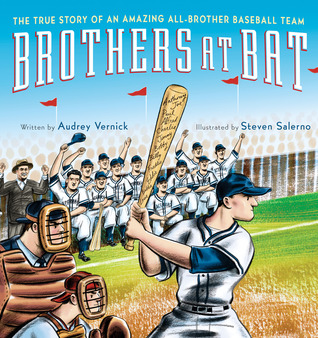
Brothers at Bat: the True Story of an Amazing All-Brother Baseball Team
Audrey Vernick, author
Stephen Salerno, illustrator
Clarion
2012
Well told and wonderfully illustrated, Brothers at Bat tells the story of 12 brothers who formed an all-brother baseball team (the longest playing all-brother team in history). Terrific family dynamics (they also had 4 sisters!), a nice slice of American history (early 20th century, including WWII), and interesting details about particular brothers make this a winner. Recommended for elementary (or earlier if they have some baseball background).
She Loved Baseball: the Effa Manley Story
Audrey Vernick, author
Don Tate, illustrator
Collins
2010
Did you know that there is a woman in the Baseball Hall of Fame? Just one actually: Effa Manley. She was an amazing woman, loved baseball, ended up owning a baseball team, and just had such an interesting life. This one's for those girls in the family who are out in the backyard hitting balls with their brothers! Recommended for elementary.
You may have heard of the new Common Core State Standards for education. If you haven't, don't worry--I plan to discuss them in more detail in the coming weeks. Whether or not your children are in public schools, these standards will affect you; after all, standardized tests are based on things exactly like this! One of the big distinctives of the new standards is the increased emphasis on "informational texts." So far, it's been hard to determine if that includes narrative nonfiction (think: biographies) as well as more information nonfiction.
At any rate, there has been a real boon of well done information picture books as of late. Three of the ones published recently center around a famous person (or persons) in baseball. Check these titles out if you have children interested in baseball, sports in general, or just for some fun "informational" reading.
There Goes Ted Williams: the Greatest Hitter Who Ever Lived
Matt Tavares
Candlewick
2012
Ted Williams could hit a ball...consistently into home run territory. His story is one of hard work, determination to be the best, consistent practice, and service to his country (WWII and Korea). The author provides a bibliography at the end as well as a note which mentions some of Williams's less-than-stellar attributes. It's a terrific story, nicely illustrated, and a great one to read with a young, aspiring baseball player. Recommended for elementary, particularly those with some prior baseball knowledge.
Brothers at Bat: the True Story of an Amazing All-Brother Baseball Team
Audrey Vernick, author
Stephen Salerno, illustrator
Clarion
2012
Well told and wonderfully illustrated, Brothers at Bat tells the story of 12 brothers who formed an all-brother baseball team (the longest playing all-brother team in history). Terrific family dynamics (they also had 4 sisters!), a nice slice of American history (early 20th century, including WWII), and interesting details about particular brothers make this a winner. Recommended for elementary (or earlier if they have some baseball background).
She Loved Baseball: the Effa Manley Story
Audrey Vernick, author
Don Tate, illustrator
Collins
2010
Did you know that there is a woman in the Baseball Hall of Fame? Just one actually: Effa Manley. She was an amazing woman, loved baseball, ended up owning a baseball team, and just had such an interesting life. This one's for those girls in the family who are out in the backyard hitting balls with their brothers! Recommended for elementary.
Friday, October 5, 2012
A Leaf Can Be...
We've been using My Father's World for our Kindergarten curriculum and reading not only the recommended books on each topic (sun, moon, leaf and apples thus far), but also just about anything we can find at our libraries on the subject.
My favorite leaf book came out this year. It's called A Leaf Can Be by Laura Purdie Salas with illustrations by Violeta Dabija. This is one I hope to add to our home library because it is beautiful, creative, poetic, informative and concise. Who would have thought that God made leaves so multi-functional?!
Here are the first few examples:
A leaf can be a
Soft cradle
Water ladle
Sun taker
Food maker
These descriptions are accompanied by soft, colorful illustrations that seem to glow, with detailed explanations and glossary at the end.
The rest of the brilliant observations are even better. Among them "skin welter," "hill glow-er," "fine healer," to mention a few. Can you imagine?! Read the book!
Best in the leaf show--well done, Salas and Dabija!
Cover image from goodreads
What other leaf books can you suggest?
My favorite leaf book came out this year. It's called A Leaf Can Be by Laura Purdie Salas with illustrations by Violeta Dabija. This is one I hope to add to our home library because it is beautiful, creative, poetic, informative and concise. Who would have thought that God made leaves so multi-functional?!
Here are the first few examples:
A leaf can be a
Soft cradle
Water ladle
Sun taker
Food maker
These descriptions are accompanied by soft, colorful illustrations that seem to glow, with detailed explanations and glossary at the end.
The rest of the brilliant observations are even better. Among them "skin welter," "hill glow-er," "fine healer," to mention a few. Can you imagine?! Read the book!
Best in the leaf show--well done, Salas and Dabija!
Cover image from goodreads
What other leaf books can you suggest?
Wednesday, September 12, 2012
Jerry Bridges: one of my all-time favorite "spirital" authors
I don't have much time for extra reading this semester; I'm homeschooling three children part-time (they're in a university model school which meets three mornings/week), I'm in my final year of coursework for my School Library/Information Science degree, and I'm still a wife and mother in the midst of it all ☺.
BUT, I'm still making time to do a book study with a friend. Why? Because we're studying a book by Jerry Bridges--one of my all-time favorite spiritual authors. I'll be reporting soon on some more children's book related items, but for now, here's a brief foray into the world of grown-up books.
Jerry Bridges has a knack for communicating spiritual truth that is at once both profound and basic. There is meat to his books, material I find myself chewing on and applying to my life even as it challenges me to go back to Scripture, to study to show myself approved, and to learn more about this great God whom we serve. And yet, his books are amazingly approachable, even if you don't have any background in the faith, if you're a newcomer to Christianity, or simply from a different denomination which has stressed slightly different aspects. (Bridges is what I would term Reformed, but I don't know what denomination he claims.) He has worked for the Navigators for the past 50 or so years! To me, the most distinctive aspects of his books are these:
I have not read all of Bridges' works (he's a prolific author!). But those listed below are all well worth taking some time out of your busy schedule to peruse. Read with pen in hand and be willing to create some marginalia!
Trusting God Even When Life Hurts
My current study. Trusting God is the most prominent part of the title on my copy; I think the second half is a bit misleading. I don't feel like life "hurts" most of the time, so I put off reading this gem until this year. This book is about trusting God. In all areas. In all situations. A reminder that God is sovereign--even over nature and nations (a timely reminder given our upcoming election season).
Transforming Grace
Wow!! This book changed my life. Really and truly. If you're familiar with Sonship, this book is similar but it starts with who God is, not who man is (and man's sin--he gets to that, but he begins first with the Lord).
Disciplines of Grace
A follow-up, in a sense, to Transforming Grace. Well worth reading and a succinct look at the practical aspects of our Christian walk.
The Gospel for Real Life
This might become my high school/college graduation gift of choice. It is EXCELLENT. Even if you've been a Christian your entire life, you will benefit from this book. A bit of rehash from Transforming Grace in parts; it would be a terrific refresher if you've read TG years ago and want to revisit it in a newer form (and with new information).
The Crisis of Caring
Another misleading title, this book sounds like it's only for those in position as care givers or perhaps those in charge of mercy ministry. Rather, it's an exploration of Christian fellowship and the ways in which we bear one another's burdens.
Next up on my Bridges-to-read list: Respectable Sins (mostly because I already own it ☺). Which Bridges book is your favorite?
Cover images from NavPress and Goodreads
BUT, I'm still making time to do a book study with a friend. Why? Because we're studying a book by Jerry Bridges--one of my all-time favorite spiritual authors. I'll be reporting soon on some more children's book related items, but for now, here's a brief foray into the world of grown-up books.
Jerry Bridges has a knack for communicating spiritual truth that is at once both profound and basic. There is meat to his books, material I find myself chewing on and applying to my life even as it challenges me to go back to Scripture, to study to show myself approved, and to learn more about this great God whom we serve. And yet, his books are amazingly approachable, even if you don't have any background in the faith, if you're a newcomer to Christianity, or simply from a different denomination which has stressed slightly different aspects. (Bridges is what I would term Reformed, but I don't know what denomination he claims.) He has worked for the Navigators for the past 50 or so years! To me, the most distinctive aspects of his books are these:
- grounded in Scripture--indeed, they overflow with Scripture references
- God-focused--it all comes back to who God is rather than focusing solely on mankind
I have not read all of Bridges' works (he's a prolific author!). But those listed below are all well worth taking some time out of your busy schedule to peruse. Read with pen in hand and be willing to create some marginalia!
Trusting God Even When Life Hurts
My current study. Trusting God is the most prominent part of the title on my copy; I think the second half is a bit misleading. I don't feel like life "hurts" most of the time, so I put off reading this gem until this year. This book is about trusting God. In all areas. In all situations. A reminder that God is sovereign--even over nature and nations (a timely reminder given our upcoming election season).
Transforming Grace
Wow!! This book changed my life. Really and truly. If you're familiar with Sonship, this book is similar but it starts with who God is, not who man is (and man's sin--he gets to that, but he begins first with the Lord).
Disciplines of Grace
A follow-up, in a sense, to Transforming Grace. Well worth reading and a succinct look at the practical aspects of our Christian walk.
The Gospel for Real Life
This might become my high school/college graduation gift of choice. It is EXCELLENT. Even if you've been a Christian your entire life, you will benefit from this book. A bit of rehash from Transforming Grace in parts; it would be a terrific refresher if you've read TG years ago and want to revisit it in a newer form (and with new information).
The Crisis of Caring
Another misleading title, this book sounds like it's only for those in position as care givers or perhaps those in charge of mercy ministry. Rather, it's an exploration of Christian fellowship and the ways in which we bear one another's burdens.
Next up on my Bridges-to-read list: Respectable Sins (mostly because I already own it ☺). Which Bridges book is your favorite?
Cover images from NavPress and Goodreads
Tuesday, September 4, 2012
Beyond Courage: WWII Nonfiction for Teens
Beyond Courage: The Untold Story of Jewish Resistance During the Holocaust
Doreen Rappaport
Candlewick
2012
NCTE Orbis Pictus Recommended Book (2013)
(updated 1/29/13)
I think it fitting that this book is scheduled to be published on September 11--a day of significance for Americans. This book describes the countless ways teens and 20-somethings stood up to the terrorism of the Nazis during WWII.
I've read a lot of WWII-era fiction for middle grade and high school students (some of it quite well done: Code Name Verity, Between Shades of Gray, My Friend the Enemy, Number the Stars, etc.). In fact, each of those titles I just mentioned covers a different aspect: spies captured and held in Nazi-occupied France, the Russians' forced deportations of Eastern Europeans, Japanese-American tension in Northwest U.S., and concentration camps, respectively).
Beyond Courage takes us behind the scenes, as it were, and tells the true stories that aren't as familiar: a 12-year-old violinist taking notes back to the Jewish Resistance after his performances for Germans in a Nazi-occupied country, desperate escape attempts from cattle cars and camps, refugee camps set up in the middle of a forest, parents who had to send their young children on train to strangers, and many others. Divided in several sections, this book covers much more than concentration camps. It also includes photographs, a lengthy bibliography (including websites) and a nice chronology of important Nazi-related dates.
Beyond Courage will be a nice addition to a study of the era for middle or high school students. The information is not sensationalized and, although covering a tragic and harsh time in history, is presented in a way that will be palatable to older middle school students as well as high school students.
Book cover image from goodreads; ARC from netgalley
Doreen Rappaport
Candlewick
2012
NCTE Orbis Pictus Recommended Book (2013)
(updated 1/29/13)
I think it fitting that this book is scheduled to be published on September 11--a day of significance for Americans. This book describes the countless ways teens and 20-somethings stood up to the terrorism of the Nazis during WWII.
I've read a lot of WWII-era fiction for middle grade and high school students (some of it quite well done: Code Name Verity, Between Shades of Gray, My Friend the Enemy, Number the Stars, etc.). In fact, each of those titles I just mentioned covers a different aspect: spies captured and held in Nazi-occupied France, the Russians' forced deportations of Eastern Europeans, Japanese-American tension in Northwest U.S., and concentration camps, respectively).
Beyond Courage takes us behind the scenes, as it were, and tells the true stories that aren't as familiar: a 12-year-old violinist taking notes back to the Jewish Resistance after his performances for Germans in a Nazi-occupied country, desperate escape attempts from cattle cars and camps, refugee camps set up in the middle of a forest, parents who had to send their young children on train to strangers, and many others. Divided in several sections, this book covers much more than concentration camps. It also includes photographs, a lengthy bibliography (including websites) and a nice chronology of important Nazi-related dates.
Beyond Courage will be a nice addition to a study of the era for middle or high school students. The information is not sensationalized and, although covering a tragic and harsh time in history, is presented in a way that will be palatable to older middle school students as well as high school students.
Book cover image from goodreads; ARC from netgalley
Friday, August 24, 2012
It's Not All Black and White
It's Not All Black and White:
Multiracial Youth Speak Out
St. Stephen's Community House
Annick Press
2012
This is a fascinating look into the world of those who aren't easily "labeled" as one race or ethnicity. I realized in reading it just how much I think in terms of racial or ethnic categories--not because I'm trying to ostracize one group or favor another, but because it seems easier to lump books and people into particular categories. Maybe it's the teacher and librarian in me who likes to know how to classify a book so that I could fit it into a lesson plan or match it up with a student. But this book shows readers that all is not black and white. There are many people in our country who don't easily fit into one ethnic or racial group.
Multiracial Youth Speak Out
St. Stephen's Community House
Annick Press
2012
This is a fascinating look into the world of those who aren't easily "labeled" as one race or ethnicity. I realized in reading it just how much I think in terms of racial or ethnic categories--not because I'm trying to ostracize one group or favor another, but because it seems easier to lump books and people into particular categories. Maybe it's the teacher and librarian in me who likes to know how to classify a book so that I could fit it into a lesson plan or match it up with a student. But this book shows readers that all is not black and white. There are many people in our country who don't easily fit into one ethnic or racial group.
Monday, July 23, 2012
Speed to Glory: the Cullen Jones Story
Natalie Davis Miller
Zonderkidz
2012
As I mentioned in my review of a Dominique Dawes biography, one of the Olympic sports I really enjoy watching is the swimming. Cullen Jones is just that: an Olympic swimmer. In fact, he's on the 2012 U.S.A. Olympic team for the upcoming London Olympics! You might consider this, then, a partial biography of Cullen Jones since his career is very much in progress.
I like what Zondervan seems to be doing in these middle grade biographies: profiling famous people who claim that their faith is important to them. If Jones' and Dawes' biographies are any indication, they are fairly well researched, easy to read, full of extra information on the sport (or career) in question--including nice bibliographies, and seem to cover a wide variety of interests (sports, politics, etc.). Jones, like Dawes, is now involved in reaching out to communities, trying to encourage kids to be more active physically. He is trying to use his gifts for good. He had a unique start to his swimming career (a near drowning at a water park at age 5), but once he got started swimming, he kept it up.
What I am less pleased about in these biographies is the generic quality of the faith of the person in question. There are occasional references to how much the person's "faith" means to them, and in both Dawes' and Jones' backgrounds, there was frequent church attendance, perhaps mention of a conversion experience, and parents who seemed to place a priority on going to church. But there was no mention of Christ nor much text devoted to object of the person's faith.
All in all, this Cullen Jones biography will be an interesting read for those kids interested in swimming (and/or professional athletes), and it will be a "safe" read and a mildly inspiring one. But it will not be terribly inspiring in terms of Christian faith.
Book is on sale now.
Thanks to Zonderkidz (via Netgalley) for the ARC of the book; cover image from Zondervan
Natalie Davis Miller
Zonderkidz
2012
As I mentioned in my review of a Dominique Dawes biography, one of the Olympic sports I really enjoy watching is the swimming. Cullen Jones is just that: an Olympic swimmer. In fact, he's on the 2012 U.S.A. Olympic team for the upcoming London Olympics! You might consider this, then, a partial biography of Cullen Jones since his career is very much in progress.
I like what Zondervan seems to be doing in these middle grade biographies: profiling famous people who claim that their faith is important to them. If Jones' and Dawes' biographies are any indication, they are fairly well researched, easy to read, full of extra information on the sport (or career) in question--including nice bibliographies, and seem to cover a wide variety of interests (sports, politics, etc.). Jones, like Dawes, is now involved in reaching out to communities, trying to encourage kids to be more active physically. He is trying to use his gifts for good. He had a unique start to his swimming career (a near drowning at a water park at age 5), but once he got started swimming, he kept it up.
What I am less pleased about in these biographies is the generic quality of the faith of the person in question. There are occasional references to how much the person's "faith" means to them, and in both Dawes' and Jones' backgrounds, there was frequent church attendance, perhaps mention of a conversion experience, and parents who seemed to place a priority on going to church. But there was no mention of Christ nor much text devoted to object of the person's faith.
All in all, this Cullen Jones biography will be an interesting read for those kids interested in swimming (and/or professional athletes), and it will be a "safe" read and a mildly inspiring one. But it will not be terribly inspiring in terms of Christian faith.
Book is on sale now.
Thanks to Zonderkidz (via Netgalley) for the ARC of the book; cover image from Zondervan
Labels:
ARC,
Biography,
Boy Protagonist(s),
Middle Grades,
Nonfiction,
Sports
Friday, July 13, 2012
Heart of a Champion: the Dominique Dawes Story
Kim Washburn
Zonderkidz
2012
The Summer Olympics are just around the corner! Sports enthusiasts everywhere are marking their calendars. One of my favorite events to watch in the Summer Olympics is the gymnastics competition (my other favorites are track-and-field and swimming, just for the record). The gymnasts, though, really seem to defy gravity and the normal bounds of the human body. Dominique Dawes is a gymnast I remember well; she is my age, and she was a remarkable athlete on so many levels.
Kim Washburn
Zonderkidz
2012
The Summer Olympics are just around the corner! Sports enthusiasts everywhere are marking their calendars. One of my favorite events to watch in the Summer Olympics is the gymnastics competition (my other favorites are track-and-field and swimming, just for the record). The gymnasts, though, really seem to defy gravity and the normal bounds of the human body. Dominique Dawes is a gymnast I remember well; she is my age, and she was a remarkable athlete on so many levels.
Labels:
ARC,
Girl Protagonist(s),
Middle Grades,
Nonfiction,
Sports
Thursday, July 12, 2012
Betsy's Summer Nonfiction Reads (Weekly Round-up)
Not much reading on the homefront these days. I've been cooking more, working on some heavy duty (and hitherto neglected) cleaning chores, spending some lovely extended evenings with friends, and enjoying play time with the kids. I've also read several interesting nonfiction books this summer--these are slower reads than the middle grades fiction I can whip through, so my "tally" in terms of numbers isn't as high. But since I'm not doing homework this summer (yea!), I've had more brain power to devote to books like these. Here is a snapshot of what I've been reading (in no particular order):
Simplicity Parenting by Kim John Payne
A GREAT book all the way around as far as encouraging you to reign in commitments, toys, and other cluttering items in your life. While this book is from a secular perspective, I thought it dovetailed nicely with many Christian books I've read on parenting as well. Definitely worth a read--it's nice to have an "expert" be reassuring us we don't have to keep up with the Joneses and have our 4-year-olds competing in soccer, training for a ballet career, or going to extra academic classes to get ahead. It's a good reminder, too, to analyze our house's collection of play equipment, to reevaluate our routines (from food to sleep to general schedule), and to enjoy a little more time with one another.
10 Things Parents Must Teach Their Children by Edith Schaeffer
I've recently reviewed this gem, so I'll do more than to say it's worth reading--whether or not you're a parent!
Calm My Anxious Heart by Linda Dillow
This book has been recommended to me several times over the years when various friends of mine have read it and thoroughly enjoyed it. I finally picked it up--and am glad I did! Dillow, very biblically, explores many issues surrounding contentment, or the lack thereof. Very convicting, even if you think you don't really struggle with contentment (she covers lots of ground here).
Before the Throne of God by Carol J. Ruvolo
I've been reading this for my women's Bible study at church, and it's pretty good. I have mild quibbles with the writing style here and there (I did, also, with Dillow's book). Overall, though, it's very Biblical, and challenges us to pray using Scripture as our base.
Child of Mine: Feeding with Love and Good Sense by Ellyn Satter
Explores how parents should (but often do not) feed their children, how to encourage children to eat more variety--particularly vegetables, and things like that. Her big push is the division of labor: parents choose when, what, and how to serve food-wise; children choose how much to eat. Much of this book is devoted to infant and toddler feeding needs/strategies/recommendations. I skipped those chapters. Worth reading for those interested in these sorts of things, but I don't 100% agree with everything (isn't that always the case?! ☺).
French Kids Eat Everything by Karen Le Billon
Wow! One of my favorite reads this summer (so far ☺). A Canadian woman married to a Frenchman; they decide to spend a year in Brittany near his family and their children are preschool and kindergarten ages. What follows is an unintended expose of some of the poorer North American habits and attitudes towards food (particularly where children are concerned) and a fascinating comparison to the French attitude. Not rocket science, but very interesting and inspiring--in part because it reminded me of the general attitude toward food in Europe and so much of the rest of the world. Let's not focus so much on health, per se, but on enjoying and savoring our food rather than gobbling down "our money's worth" at an all-you-can-eat-buffet, on anticipating the next meal instead of grabbing a mediocre snack to tide us over, and on the social component of eating together.
An Economist Gets Lunch: New Rules for Everyday Foodies by Tyler Cowen
Another interesting, albeit slower, read. If you, like me, enjoy reading and discussing food-related issues (everything from finding a good ethnic restaurant to musing over the seeming tension between locavores and big agribusiness to celebrating BBQ to wondering why the American food scene is the way it is...), then you will no doubt find this book interesting. As a former English teacher, I think this book might be easier to listen to; he may write well for an economist but the paucity of punctuation at times and the general writing style sometimes gets on my nerves ☺.
Simplicity Parenting by Kim John Payne
A GREAT book all the way around as far as encouraging you to reign in commitments, toys, and other cluttering items in your life. While this book is from a secular perspective, I thought it dovetailed nicely with many Christian books I've read on parenting as well. Definitely worth a read--it's nice to have an "expert" be reassuring us we don't have to keep up with the Joneses and have our 4-year-olds competing in soccer, training for a ballet career, or going to extra academic classes to get ahead. It's a good reminder, too, to analyze our house's collection of play equipment, to reevaluate our routines (from food to sleep to general schedule), and to enjoy a little more time with one another.
10 Things Parents Must Teach Their Children by Edith Schaeffer
I've recently reviewed this gem, so I'll do more than to say it's worth reading--whether or not you're a parent!
Calm My Anxious Heart by Linda Dillow
This book has been recommended to me several times over the years when various friends of mine have read it and thoroughly enjoyed it. I finally picked it up--and am glad I did! Dillow, very biblically, explores many issues surrounding contentment, or the lack thereof. Very convicting, even if you think you don't really struggle with contentment (she covers lots of ground here).
Before the Throne of God by Carol J. Ruvolo
I've been reading this for my women's Bible study at church, and it's pretty good. I have mild quibbles with the writing style here and there (I did, also, with Dillow's book). Overall, though, it's very Biblical, and challenges us to pray using Scripture as our base.
Child of Mine: Feeding with Love and Good Sense by Ellyn Satter
Explores how parents should (but often do not) feed their children, how to encourage children to eat more variety--particularly vegetables, and things like that. Her big push is the division of labor: parents choose when, what, and how to serve food-wise; children choose how much to eat. Much of this book is devoted to infant and toddler feeding needs/strategies/recommendations. I skipped those chapters. Worth reading for those interested in these sorts of things, but I don't 100% agree with everything (isn't that always the case?! ☺).
French Kids Eat Everything by Karen Le Billon
Wow! One of my favorite reads this summer (so far ☺). A Canadian woman married to a Frenchman; they decide to spend a year in Brittany near his family and their children are preschool and kindergarten ages. What follows is an unintended expose of some of the poorer North American habits and attitudes towards food (particularly where children are concerned) and a fascinating comparison to the French attitude. Not rocket science, but very interesting and inspiring--in part because it reminded me of the general attitude toward food in Europe and so much of the rest of the world. Let's not focus so much on health, per se, but on enjoying and savoring our food rather than gobbling down "our money's worth" at an all-you-can-eat-buffet, on anticipating the next meal instead of grabbing a mediocre snack to tide us over, and on the social component of eating together.
An Economist Gets Lunch: New Rules for Everyday Foodies by Tyler Cowen
Another interesting, albeit slower, read. If you, like me, enjoy reading and discussing food-related issues (everything from finding a good ethnic restaurant to musing over the seeming tension between locavores and big agribusiness to celebrating BBQ to wondering why the American food scene is the way it is...), then you will no doubt find this book interesting. As a former English teacher, I think this book might be easier to listen to; he may write well for an economist but the paucity of punctuation at times and the general writing style sometimes gets on my nerves ☺.
Wednesday, June 27, 2012
10 Things Parents Must Teach Their Children (and Learn For Themselves)
Edith Schaeffer
Baker Books
1994
I was teaching an early elementary Sunday School class a couple of summers ago, and the curriculum kept featuring quotations from this book in the margin. And the quotations were always so good. I decided the book was worth checking out.
It's taken me a while to read this gem--not because it's hard reading, but because it's thought-provoking and meaty. I didn't want to skim through it, and I was so tired mentally from schoolwork during the school year that I often picked up lighter reading before tackling something like this.
Monday, April 30, 2012
Walking on Water: Reflections on Faith and Art
Madeleine L'Engle
North Point Press
1980
This year marks the 50th anniversary of A Wrinkle in Time. While I have vague plans to reread that marvelous book (again), I thought it might be interesting to discuss L'Engle "behind the scenes" as it were. L'Engle has written several nonfiction books; Walking on Water primarily focuses on her own writing process, her understanding of what it means to write as a Christian, and her reflections on how anyone's faith intersects with art (visual, literary, etc.).
Sunday, April 1, 2012
Parenting with Scripture
Parenting with Scripture: A Topical Guide for Teachable Moments
Kara Durbin
Moody Publishers
2012
All in all, this book delivers exactly what it says it will do: presents a handy topical guide for teachable moments, all tied to Scripture! Topics are covered in two pages each. The topic is listed and then followed by several Scripture references (actually, quite a few in some cases), then discussion questions and activities for reinforcement. Parenting tips are also sprinkled throughout as they correspond with a given topic. I appreciate the positive spin on so many topics (i.e. "honesty" and "thankfulness" are covered as well as topics like "complaining" and "anger"). This lets you easily use this book as a devotional guide with your children, covering topics as they arise in the book. Since the topics are listed alphabetically and cross-referenced in the back, it's also an easy book to use "in the moment." (The author makes a point of saying in the introduction that she couldn't find books that used Scripture in this manner; I think that's not quite true. Doorposts has some thorough resources in this vein; Don't Make Me Count to Three, Teach Them Diligently, and Shepherding a Child's Heart are also books in this vein, but they don't provide quite the practical Scripture reference guide.)
I think this book is probably most helpful with older preschoolers and up; very young children won't really "get" the questions (although you can always start memorizing Scripture with them as soon as they can talk!).
Perhaps my biggest "issue" with the book is the absence of grace, or the seeming lack of emphasis on it. Certainly we are to be working out our salvation, striving to obey the Lord, seeking to "put off the old and put on the new." But in all these things, we are more than conquerors...through Christ! We can only do these things in his strength and through his grace. Similarly, I found the explanation of the gospel a little lacking.
That being said, I still think this is eminently helpful resource for Christian parents; I plan to buy the book and will just adapt some of the information to my own Reformed theology. This new edition will be available in stores this month; check it out!
Advance review copy from netgalley; cover image from goodreads.com
Kara Durbin
Moody Publishers
2012
All in all, this book delivers exactly what it says it will do: presents a handy topical guide for teachable moments, all tied to Scripture! Topics are covered in two pages each. The topic is listed and then followed by several Scripture references (actually, quite a few in some cases), then discussion questions and activities for reinforcement. Parenting tips are also sprinkled throughout as they correspond with a given topic. I appreciate the positive spin on so many topics (i.e. "honesty" and "thankfulness" are covered as well as topics like "complaining" and "anger"). This lets you easily use this book as a devotional guide with your children, covering topics as they arise in the book. Since the topics are listed alphabetically and cross-referenced in the back, it's also an easy book to use "in the moment." (The author makes a point of saying in the introduction that she couldn't find books that used Scripture in this manner; I think that's not quite true. Doorposts has some thorough resources in this vein; Don't Make Me Count to Three, Teach Them Diligently, and Shepherding a Child's Heart are also books in this vein, but they don't provide quite the practical Scripture reference guide.)
I think this book is probably most helpful with older preschoolers and up; very young children won't really "get" the questions (although you can always start memorizing Scripture with them as soon as they can talk!).
Perhaps my biggest "issue" with the book is the absence of grace, or the seeming lack of emphasis on it. Certainly we are to be working out our salvation, striving to obey the Lord, seeking to "put off the old and put on the new." But in all these things, we are more than conquerors...through Christ! We can only do these things in his strength and through his grace. Similarly, I found the explanation of the gospel a little lacking.
That being said, I still think this is eminently helpful resource for Christian parents; I plan to buy the book and will just adapt some of the information to my own Reformed theology. This new edition will be available in stores this month; check it out!
Advance review copy from netgalley; cover image from goodreads.com
Wednesday, March 14, 2012
Warriors and Wailers: One Hundred Ancient Chinese Jobs You May Have Relished or Reviled
Sarah Tsiang, author
Martha Newbigging, illustrator
Annick Press
2012
Warriors and Wailers is a well-organized compendium of just exactly what it says: one hundred ancient Chinese jobs you may have relished or reviled. You have your standard imperial jobs, some peasant jobs, a host of civil service type jobs, jobs for men or women, jobs for which you are trained, jobs for which you have to be born in the right family, and so forth.
I found the information to be well presented. I think the reading level is just fine for middle grades, and I think there are some interesting jobs presented that will hold students' interest. However, some of the jobs are a bit sketchy. I don't know if the author is trying to give equal treatment to men and women, or if she is trying to scrounge up 100 jobs...but Imperial Consort and similar such jobs might make this book chosen by parents less often. Certainly there were some women warriors and scholars, but these were few and far between. In fairness, for jobs such as Imperial Consort, the author is discreet--saying things along the lines of a girl needs to be pretty, will keep the Emperor company, and/or needs to provide a son.
The weakest point in the book is the illustration style--many of the cartoonish characters don't even look Chinese...which is kinda the point, isn't it? After all, this is a book about ancient Chinese jobs. I found them distracting and unhelpful. It's a shame because the right illustrations would have really made a difference.
All in all, this is a book that will no doubt be a fun extra Social Studies resource for classrooms and school libraries; I don't think kids are going to pick it up to read just for fun.
ARC from netgalley; cover image from AnnickPress
Sarah Tsiang, author
Martha Newbigging, illustrator
Annick Press
2012
Warriors and Wailers is a well-organized compendium of just exactly what it says: one hundred ancient Chinese jobs you may have relished or reviled. You have your standard imperial jobs, some peasant jobs, a host of civil service type jobs, jobs for men or women, jobs for which you are trained, jobs for which you have to be born in the right family, and so forth.
I found the information to be well presented. I think the reading level is just fine for middle grades, and I think there are some interesting jobs presented that will hold students' interest. However, some of the jobs are a bit sketchy. I don't know if the author is trying to give equal treatment to men and women, or if she is trying to scrounge up 100 jobs...but Imperial Consort and similar such jobs might make this book chosen by parents less often. Certainly there were some women warriors and scholars, but these were few and far between. In fairness, for jobs such as Imperial Consort, the author is discreet--saying things along the lines of a girl needs to be pretty, will keep the Emperor company, and/or needs to provide a son.
The weakest point in the book is the illustration style--many of the cartoonish characters don't even look Chinese...which is kinda the point, isn't it? After all, this is a book about ancient Chinese jobs. I found them distracting and unhelpful. It's a shame because the right illustrations would have really made a difference.
All in all, this is a book that will no doubt be a fun extra Social Studies resource for classrooms and school libraries; I don't think kids are going to pick it up to read just for fun.
ARC from netgalley; cover image from AnnickPress
Saturday, March 3, 2012
The World in Your Lunch Box
Claire Eamer, author
Sa Broothroyd, illustrator
Annick Press
2012
Ever wondered where tomatoes originated? I'll give you a hint: it's not Italy. What about ice cream? Watermelon? Vanilla? Pita bread?
The World in Your Lunch Box is a delightful exploration of some of the foods your student might have in his or her school lunch in a given week. A teacher assigns his students the following: keep a diary of your lunch for a week and look up information about each of the parts of your lunch. Brief history, scientific information, and weird facts are presented about foods as diverse as those mentioned above, plus parts of a pizza, chocolate, corn, .... Funny little drawings punctuate the text including little jokes (i.e. Pita bread says to regular bread, "Bread, you'll never understand, you were just raised differently." Bread responds, "Pita, you're full of hot air." yuk yuk yuk)
Middle school students will enjoy this little nonfiction gem--and may come home requesting some new foods! I appreciated the way certain periods of history (i.e. colonization, spice trade, etc.) and the balance between organic and conventionally grown produce was handled. Information was given, but no judgment passed. The point of this book is not to convert anyone to a particular perspective, but to open a kid's eyes to the interesting background of a seemingly ordinary school lunch. There is a nice bibliography and thorough index in the back as well; books recommended for kids definitely come from the more politically correct persuasions, but they seem fairly well rounded.
I think a nice touch would be the addition of some kid-friendly recipes (for instance, there's a suggestion to make your own pizza...but no recipe! The making of mayonnaise is discussed--another potential recipe to try would be great there).
Recommended for upper elementary and up (reading level is not difficult, but kids will get more out of this book if they have a working knowledge of history; references are made to things such as "when the Spanish conquered the ..." without any further elaboration). Book is in stores now and hopefully will be in libraries in the near future!
Advance review copy from netgalley; cover image from goodreads
Claire Eamer, author
Sa Broothroyd, illustrator
Annick Press
2012
Ever wondered where tomatoes originated? I'll give you a hint: it's not Italy. What about ice cream? Watermelon? Vanilla? Pita bread?
The World in Your Lunch Box is a delightful exploration of some of the foods your student might have in his or her school lunch in a given week. A teacher assigns his students the following: keep a diary of your lunch for a week and look up information about each of the parts of your lunch. Brief history, scientific information, and weird facts are presented about foods as diverse as those mentioned above, plus parts of a pizza, chocolate, corn, .... Funny little drawings punctuate the text including little jokes (i.e. Pita bread says to regular bread, "Bread, you'll never understand, you were just raised differently." Bread responds, "Pita, you're full of hot air." yuk yuk yuk)
Middle school students will enjoy this little nonfiction gem--and may come home requesting some new foods! I appreciated the way certain periods of history (i.e. colonization, spice trade, etc.) and the balance between organic and conventionally grown produce was handled. Information was given, but no judgment passed. The point of this book is not to convert anyone to a particular perspective, but to open a kid's eyes to the interesting background of a seemingly ordinary school lunch. There is a nice bibliography and thorough index in the back as well; books recommended for kids definitely come from the more politically correct persuasions, but they seem fairly well rounded.
I think a nice touch would be the addition of some kid-friendly recipes (for instance, there's a suggestion to make your own pizza...but no recipe! The making of mayonnaise is discussed--another potential recipe to try would be great there).
Recommended for upper elementary and up (reading level is not difficult, but kids will get more out of this book if they have a working knowledge of history; references are made to things such as "when the Spanish conquered the ..." without any further elaboration). Book is in stores now and hopefully will be in libraries in the near future!
Advance review copy from netgalley; cover image from goodreads
Friday, March 2, 2012
Amelia Lost
Amelia Lost: the Life and Disappearance of Amelia Earhart
Candace Fleming
Schwartz & Wade Books
2011
This book received a lot of blogger buzz last year, but it didn't receive much awards attention (OK, none, really) when the Caldecott/Newbery/et. al. were announced earlier this year. Now that I've read it, I can see why the buzz!
Fleming tells us the story of Amelia Earhart in an engaging, readable format. Amelia's biographical story is broken up into chapters and interspersed with "chapters" of her disappearance and subsequent rescue attempts. I liked this dual plot thread which all coalesced at the end of the book. Knowing she is missing heightens some of the details Fleming gives us about her character and her decisions in her earlier life.
Fleming manages to give us a very likable and sympathetic heroine--but also a very real one, complete with faults and poor decision making. This is a true story of a brave woman, but it is also the true story of a human being like the rest of us. There are mild feminism undertones, but they are also reflections of a time during which women did need to gain a bit more independence (i.e. the right to vote!).
Candace Fleming
Schwartz & Wade Books
2011
This book received a lot of blogger buzz last year, but it didn't receive much awards attention (OK, none, really) when the Caldecott/Newbery/et. al. were announced earlier this year. Now that I've read it, I can see why the buzz!
Fleming tells us the story of Amelia Earhart in an engaging, readable format. Amelia's biographical story is broken up into chapters and interspersed with "chapters" of her disappearance and subsequent rescue attempts. I liked this dual plot thread which all coalesced at the end of the book. Knowing she is missing heightens some of the details Fleming gives us about her character and her decisions in her earlier life.
Fleming manages to give us a very likable and sympathetic heroine--but also a very real one, complete with faults and poor decision making. This is a true story of a brave woman, but it is also the true story of a human being like the rest of us. There are mild feminism undertones, but they are also reflections of a time during which women did need to gain a bit more independence (i.e. the right to vote!).
Subscribe to:
Posts (Atom)